Introduction
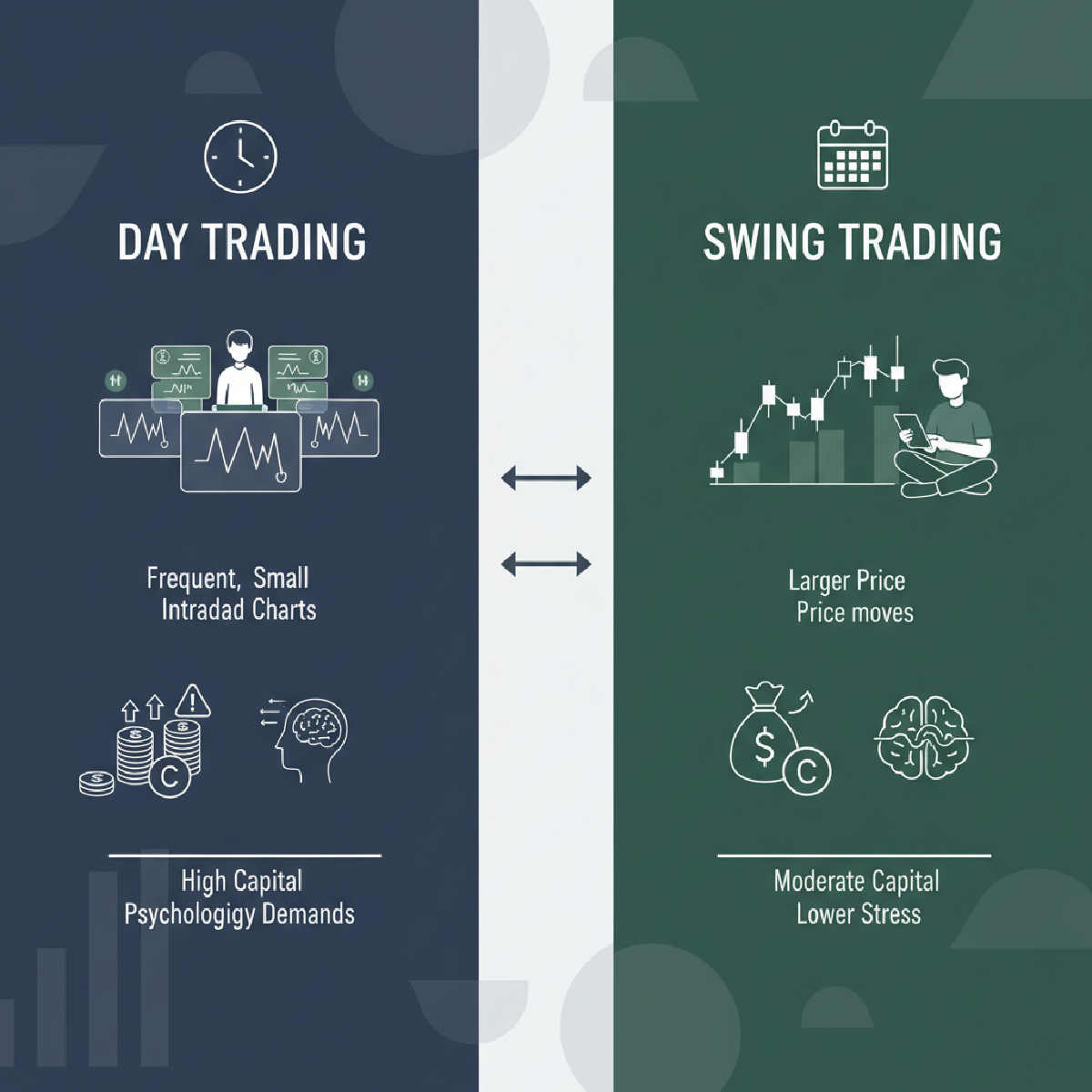
Day trading and swing trading both aim to profit from short- to medium-term price moves, but they demand completely different schedules, capital buffers, and temperaments. Day trading requires focused screen time during active market hours and rapid execution, whereas swing trading holds positions for several days to weeks and fits around a full-time job. Choosing a style that clashes with your schedule or account size is one of the fastest ways to burn out or over-risk your capital.
How Day Trading Works
A typical equity day trader prepares before the 9:30 a.m. ET open, scanning overnight news, earnings catalysts, and pre-market volume to build a focused watchlist. Trades are opened and closed within the same session — holding nothing overnight — to avoid gap risk, using defined stops sized with a position size calculator. Because intraday moves are smaller, per-trade commissions and spreads take a larger bite out of returns (see our broker fee calculator).
Time Commitment Required
Day trading demands a substantial time commitment:
- Before market open: 15-30 minutes for news and planning
- Market hours (9:30 a.m. - 4:00 p.m.): 6-7 hours of active trading
- After market close: 30-60 minutes reviewing trades and preparing for the next day
In total, this amounts to about 7-8 hours each day, five days a week, resembling a full-time job where you are your own boss.
Typical Day Trading Strategies
Common strategies include:
- Momentum Trading: Targeting stocks with strong directional moves.
- Gap and Go: Capitalizing on stocks that gap up on news.
- Scalping: Making numerous small trades for cents per share.
- News Trading: Acting on economic announcements or earnings.
- Opening Range Breakout: Trading breakouts from the initial price range.
What is Swing Trading?

Swing trading takes a different approach, focusing on holding positions for several days to weeks to capture broader price movements. A swing trader might buy a stock on Monday and sell it the following Friday.
How Swing Trading Works
Swing traders typically review daily and 4-hour charts outside market hours, looking for multi-day setups such as pullbacks to support or moving averages in an established trend. Orders and stop-losses can be placed in advance, requiring far less screen time during the day.
Time Commitment Required
Swing trading is much less intensive:
- Evening analysis: 30-45 minutes
- Morning check: 10-15 minutes
- Exit execution: 5-10 minutes
- Planning: 20-30 minutes
Totaling just 1-2 hours per week, swing trading can easily fit around a full-time job or other responsibilities.
Typical Swing Trading Strategies
Common strategies include:
- Trend Following: Buying pullbacks in uptrends.
- Support/Resistance Trading: Trading at key levels.
- Chart Pattern Trading: Utilizing setups like flags and triangles.
- Moving Average Crossovers: Using moving averages for signals.
- Momentum with Fundamentals: Merging fundamental analysis with technical entry points.
Key Differences: Day Trading vs. Swing Trading
Understanding the differences between these two approaches is essential:
- Time Commitment: Day trading requires full-time hours, while swing trading can be managed in a few hours each week.
- Capital Requirements: US stock day traders historically needed a $25,000 margin balance under FINRA’s Pattern Day Trader rule; since June 4, 2026 a risk-based Intraday Margin Standard applies instead, with broker transition until October 20, 2027 — check which regime your account is under. Swing traders can start with as little as $500.
- Risk Levels: Day trading avoids overnight gap risks but adds pressure for quick decisions. Swing trading carries gap risks but allows for more thoughtful decision-making.
- Profit Potential: Day traders often aim for small percentage gains across multiple trades, while swing traders target larger percentage gains per trade, making them more attainable for the average trader.
Pros and Cons of Each Approach
Day Trading Pros and Cons
Advantages:
- High income potential for successful traders
- No overnight gap risk
- Immediate profit realization
Disadvantages:
- Historically required $25,000 minimum margin equity (PDT rule; replaced by the Intraday Margin Standard in 2026, broker transition to Oct 2027)
- Full-time commitment makes it challenging to juggle other responsibilities
- High stress and psychological exhaustion
Swing Trading Pros and Cons
Advantages:
- Compatible with full-time employment
- Lower capital requirements
- Less stressful and more sustainable
Disadvantages:
- Exposure to overnight gaps
- Requires patience and discipline
Which Should You Choose?

To make an informed decision, consider these factors:
- Capital Available: With a smaller account, swing trading avoids US day-trading margin constraints entirely.
- Time Available: If you work full-time, swing trading is likely the only viable choice.
- Personality Type: If quick decisions cause you stress, swing trading may be a better fit.
Can You Do Both?
Yes, many traders successfully combine swing trading as their primary strategy with day trading as a secondary activity. Just be mindful of keeping day trades within the limits to avoid PDT rules.
Getting Started: Next Steps for Each Path
If You Choose Swing Trading
- Open a brokerage account (consider Webull or E*TRADE).
- Spend a couple of weeks paper trading to test your strategies.
- Learn the basics of technical analysis.
- Focus on a few select stocks to avoid spreading yourself too thin.
- Document your trades to refine your approach.
If You Choose Day Trading
- Save up to $25,000.
- Familiarize yourself with day trading strategies.
- Practice extensively with paper trading.
- Start with only 1-2 trades each day.
Conclusion
Your choice between day trading and swing trading can significantly impact your trading experience. While day trading can offer high returns, it comes with intense demands and risks. Conversely, swing trading provides a more sustainable path for many traders.
Before diving into day trading, consider starting with swing trading to see what fits your lifestyle and goals. Commit to mastering the approach you choose.
Next step: Determine which trading style aligns with your life and dedicate 2-4 weeks to learning and paper trading that specific style. Successful traders are those who approach their path with honesty and a commitment to mastery.
How Crypto Changes the Comparison (24/7 Markets)
In cryptocurrency markets, the structural rules differ in three important ways:
- No Pattern Day Trader (PDT) rule: Spot and derivatives crypto exchanges do not enforce the US $25,000 equity margin minimum, so small accounts can day trade or swing trade freely.
- 24/7 continuous trading: Crypto never closes for evenings or weekends. For day traders, that means flexible session timing (often around US/EU market overlaps when liquidity peaks) — but also a higher risk of fatigue and overtrading. For swing traders, there are no weekend opening gaps, though sharp moves can trigger stop-losses while you sleep.
- Perpetual funding & liquidation risk: Crypto swing traders holding perpetual futures across multiple days pay or receive periodic funding every 8 hours (estimate carry with our funding rate calculator). Not sure which style fits your schedule? Take our 1-minute trader style quiz.
Related Reading
- Day Trading Strategies: 10 That Actually Work
- How to Start Trading with $500
- What Is Active Trading? Complete Beginner’s Guide
- Best Crypto Trading Platforms Compared
Educational content only — not financial advice. Active trading involves substantial risk of loss.