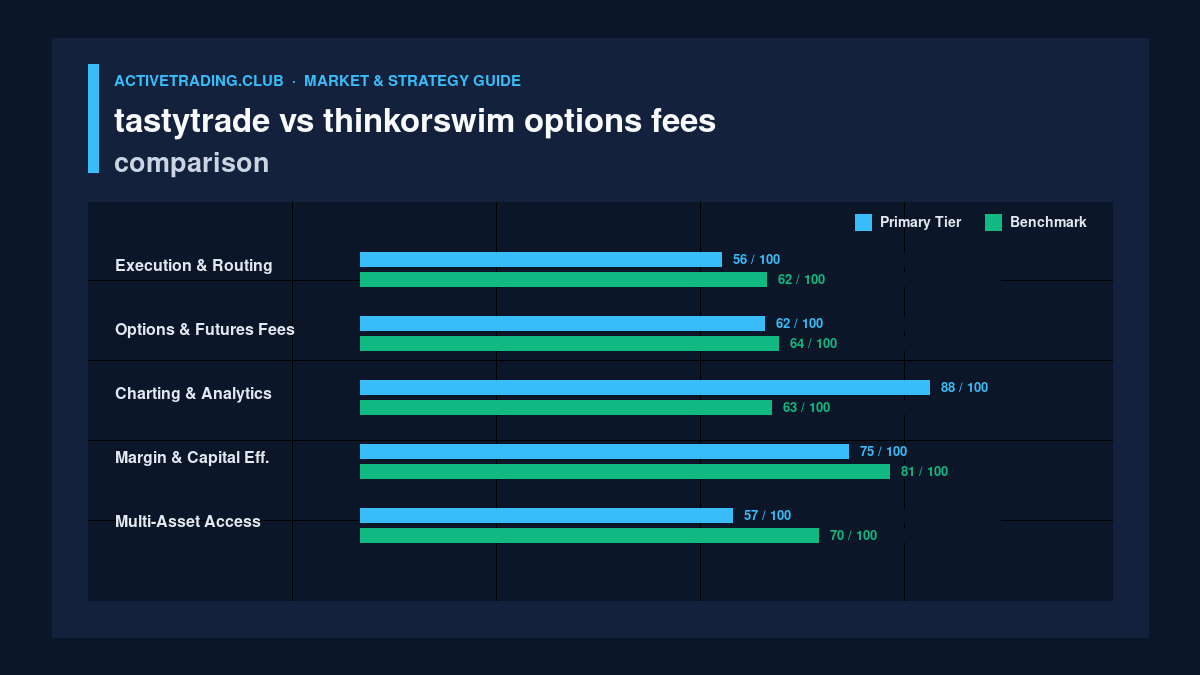
tastytrade (Visit tastytrade) and thinkorswim (Visit Schwab) are the two names that come up in every “best options platform” thread — and they share DNA. thinkorswim was built by Tom Sosnoff’s team, sold to TD Ameritrade, and absorbed into Charles Schwab after the merger; Sosnoff’s crew then built tastytrade as the options-first successor. One is a free professional platform bundled with a full-service broker; the other is a lean commission structure wrapped around an options-native interface.
Below we compare both on verified October 2026 fee schedules, work through the real cost math — including where tastytrade’s $10-per-leg cap actually bites — and map each platform to the trader it fits.
Side-by-Side Comparison (Verified October 2026)
Fee data verified on 2026-10-19 against the tastytrade pricing page and Charles Schwab pricing. Headline rates exclude exchange, clearing, OCC/NFA, and regulatory pass-through fees.
| Feature / Fee | tastytrade (Visit) | thinkorswim at Schwab (Visit) |
|---|---|---|
| Best For | Active options and futures traders who think in probabilities | Options traders who want a free pro-grade platform plus full-service brokerage, research, and banking |
| Regional Availability | US only | US only |
| US Stocks & ETFs | $0 commission | $0 commission online |
| Equity/Index Options | $1.00/contract to open — capped at $10/leg; $0 to close | $0.65/contract each side; contract fee waived on online buy-to-close orders ≤$0.05 |
| Multi-leg Orders | Per-leg cap applies — a 4-leg spread never costs more than $40 to open | $0.65/contract on every leg, both sides |
| Standard Futures | $1.00/contract/side (E-mini) | $2.25/contract/side |
| Micro/E-nano Futures | $0.75/contract/side | $2.25/contract/side — no published micro rate |
| Options on Futures | $1.25/contract ($0.75 micro) | $2.25/contract/side |
| Spot Crypto | 1% of trade value (0.75% on BTC/ETH) | No spot crypto — ETF and CME futures exposure only |
| Spot Forex | No | Yes |
| Flagship Platform | tastytrade web/desktop/mobile — probability, IV rank, defined-risk spreads | thinkorswim desktop/web/mobile — charting, thinkScript, Market Maker Move |
| Paper Trading | Yes (paper trading account) | paperMoney — full simulator with virtual funding |
| Research & Education | tastylive network, options-focused content | Schwab research, education library, coaching |
| API / Automation | Public tastytrade API | Schwab Developer API (successor to the TD Ameritrade API) |
| Account Minimum | $0 | $0 |
Real Trade Cost Math: The $10 Cap in Action

tastytrade’s pricing reads similar to Schwab’s at small size — $1.00 versus $0.65 per contract — but two mechanics change the picture as volume grows: closes are always free, and opens cap at $10 per leg per order. Here is what that does at real monthly volumes (all figures are round-trip commissions on the verified schedules).
Scenario 1: Ten Contracts a Month (One 10-Lot Round Trip)
- tastytrade:
10 × $1.00open (at the $10 cap) +$0close = $10.00 - thinkorswim:
10 × $0.65 × 2 sides= $13.00 - Winner: tastytrade — cheaper even at entry size, because closes cost nothing.
Scenario 2: Fifty Contracts a Month
- As five 10-lot round trips: tastytrade
5 × $10= $50.00 vs thinkorswim50 × $1.30= $65.00 - As one 50-lot round trip: tastytrade $10.00 (cap) vs thinkorswim $65.00
- Winner: tastytrade — the cap rewards traders who clip orders into larger tickets; the bigger your average order, the harder Schwab’s flat per-contract rate loses.
Scenario 3: Two Hundred Contracts a Month (Premium Seller)
- In 10-lot clips (20 orders): tastytrade
20 × $10= $200.00 vs thinkorswim200 × $1.30= $260.00 - In 50-lot clips (4 orders): tastytrade
4 × $10= $40.00 vs thinkorswim $260.00 — a 6.5× gap - Winner: tastytrade, decisively — this is the profile tastytrade was built for: high-frequency defined-risk sellers.
Scenario 4: Iron Condor Round Trips (4 Legs)
- 10 contracts per leg: tastytrade
4 × $10= $40.00 to open, $0 to close → $40.00 RT; thinkorswim4 × 10 × $0.65 × 2= $52.00 RT - 20 contracts per leg: tastytrade still $40.00 (cap) vs thinkorswim
4 × 20 × $0.65 × 2= $104.00 RT - Schwab’s one counterweight: buy-to-close orders at $0.05 or less carry no contract fee — so letting cheap short legs expire or covering them for a nickel costs $0 at both brokers. But every close above $0.05 is still $0 at tastytrade and $0.65/contract at Schwab.
Scenario 5: Futures Trader (100 Sides a Month)
- Standard E-minis: tastytrade
100 × $1.00= $100.00 vs thinkorswim100 × $2.25= $225.00 - Micro E-minis: tastytrade
100 × $0.75= $75.00 vs thinkorswim100 × $2.25= $225.00 — no micro discount published - Winner: tastytrade — 2.25× cheaper on standard contracts, 3× on micros.
Use the Broker Fee Calculator embedded on this page to model your exact monthly options and futures volume across all 10 brokers in our dataset.
Platform & Workflow: Where thinkorswim Earns Its Keep

The fee table says tastytrade everywhere — so why does thinkorswim still headline every platform ranking? Because the platform is the product, and it is free.
Why Traders Stay on thinkorswim
- paperMoney: a full-fidelity simulator with virtual cash — the standard way US traders rehearse options strategies before risking a dollar.
- thinkScript + charting: custom studies, scans, and alerts that approach a scripting language; deeper charting than tastytrade’s streamlined interface.
- Full-service wrapper: Schwab research, education, forex trading, banking, and branches — none of which tastytrade attempts.
- $0 entry cost: every Schwab account gets the whole platform; you pay standard commissions only when you trade.
- Trade-offs: $0.65/contract with no cap punishes larger option orders, $2.25 futures pricing is the most expensive in our 10-broker dataset alongside full-service peers, and there is no spot crypto.
Why Options Natives Pick tastytrade
- The $10/leg cap + $0 closes: structural, not promotional — at scale it is the cheapest options commission schedule among mainstream US brokers in our data.
- Options-native interface: positions visualized as probability curves, IV rank and expected move surfaced everywhere, defined-risk spreads as first-class order types.
- Crypto included: spot crypto inside the same account (1%, 0.75% on BTC/ETH) for traders who want one login.
- Trade-offs: assumes options fluency — thinner hand-holding and research than Schwab; no forex; US residents only.
Who Should Choose Which Platform?
- Choose tastytrade if:
- Options commissions are a real line item — you sell premium, run multi-leg spreads, or trade more than ~20 contracts a month.
- You want futures and micros at $1.00/$0.75 instead of a flat $2.25.
- You already think in probabilities and want a platform that does too.
- Choose thinkorswim at Schwab if:
- You are learning options — paperMoney, thinkScript, and Schwab’s education stack are worth more than the commission gap at small size.
- You want one institution for trading, research, banking, and forex.
- Your orders are small enough that $0.65/contract barely differs from $1.00-open-$0-close — roughly under 10 contracts a month, the difference is single-digit dollars.
Compare the rest of the field — Interactive Brokers, TradeStation, E*TRADE, Webull and more — in our Interactive Broker Finder, and size every trade before entry with the Position Size Calculator.
Frequently Asked Questions
Is tastytrade or thinkorswim cheaper for options trading?
On commissions, tastytrade is cheaper on every row of the verified schedule: $1.00 per contract to open (capped at $10 per leg) and $0 to close, versus thinkorswim/Schwab’s $0.65 per contract on both the open and the close. A 10-lot round trip costs $10 at tastytrade versus $13 at Schwab, and the gap widens with order size — a single 50-lot costs $10 at tastytrade versus $65 at Schwab. thinkorswim’s counter-argument is that the platform itself is free with any Schwab account.
Is thinkorswim free, and who owns it?
Yes — thinkorswim (ToS) is Charles Schwab’s flagship trading platform and costs nothing to use with a Schwab account, including the paperMoney simulator. thinkorswim was built by Tom Sosnoff’s team, acquired by TD Ameritrade in 2009, and moved to Schwab after the Schwab–TD Ameritrade merger. Sosnoff’s team went on to found tastytrade — which is why the two platforms feel like cousins.
Which is cheaper for futures — tastytrade or thinkorswim?
tastytrade by a wide margin. It charges $1.00 per contract per side on E-mini futures and $0.75 on micros and E-nanos; thinkorswim/Schwab charges a flat $2.25 per contract per side on futures and futures options with no published micro rate. A 100-side month on standard contracts costs about $100 at tastytrade versus $225 at Schwab.
Which platform is better for beginners — tastytrade or thinkorswim?
thinkorswim is the friendlier starting point: the paperMoney simulator, thinkScript charting, Schwab’s research and education library, and a full-service brokerage behind it. tastytrade assumes you already think in options terms — its interface is built around probability, IV rank, and defined-risk spreads, which rewards experienced options traders but gives beginners less scaffolding.
Do tastytrade and thinkorswim offer crypto and forex?
tastytrade offers spot crypto at a 1% commission (0.75% on BTC and ETH) but no forex. Schwab offers spot forex through thinkorswim but no direct spot crypto — exposure is via crypto ETFs and CME futures only.
Related Reading
- Interactive Brokers vs tastytrade (2026) — IBKR’s tiered pricing vs the $10 cap
- Interactive Brokers vs Schwab (thinkorswim) 2026
- TradeStation vs Interactive Brokers (2026) — another volume-tiered options schedule
- TradingView vs thinkorswim — charting platform vs broker platform
- Broker Fee Calculator — model monthly commissions for your exact trade volume
Educational comparison only — not financial advice or a recommendation to open an account. Options and futures trading involves substantial risk of loss and is not suitable for every investor. Fee figures were verified against each broker’s official pricing schedule on October 19, 2026; always confirm current rates, fees, and regional availability on the broker’s website before funding an account.