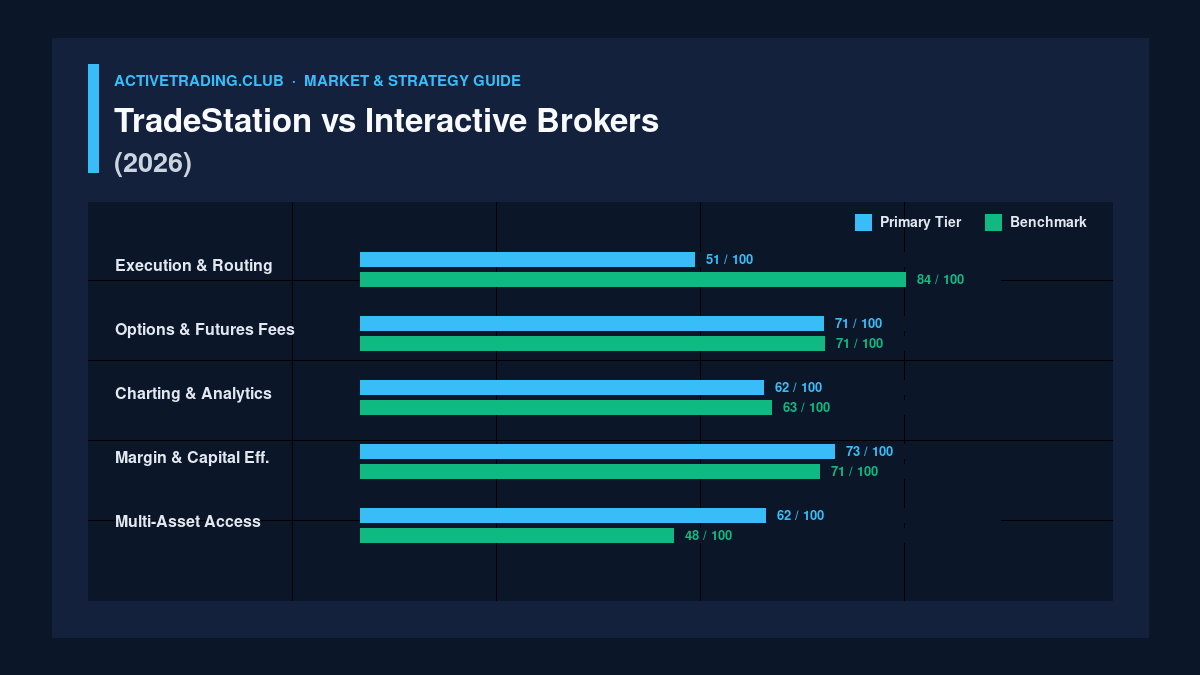
TradeStation (TradeStation) and Interactive Brokers (IBKR) both court the same trader: active, cost-sensitive, and often systematic. But they get there differently. TradeStation is a US-centric pro platform whose tiered commissions fall toward $0 as monthly volume climbs, wrapped in EasyLanguage strategy tooling. Interactive Brokers is the global multi-asset benchmark: 150+ market centers, the lowest entry-tier futures commissions among mainstream brokers, benchmark-plus margin rates, and mature APIs.
Below we compare both on verified October 2026 fee schedules, work through real options and futures cost math, and map each platform to the trading styles it fits.
Side-by-Side Comparison (Verified October 2026)
Fee data verified on 2026-10-19 against TradeStation Pricing and Interactive Brokers Commissions. Headline rates exclude exchange, clearing, NFA, and regulatory pass-through fees. TradeStation tiers are set per asset class by the prior month’s volume: Tier 1 = 0–500 contracts, Tier 2 = 501–1,000, Tier 3 = 1,001–10,000, Tier 4 = >10,000.
| Feature / Fee | TradeStation (Visit TradeStation) | Interactive Brokers (Visit IBKR) |
|---|---|---|
| Best For | US active traders, options spread traders, EasyLanguage strategy builders | Global multi-asset traders, futures scalpers, API/algo traders, margin users |
| Regional Availability | US primary (international clients via TradeStation International on a separate schedule, e.g. options $5 base + $0.10/contract) | Global (150+ market centers; local entities and multi-currency funding) |
| US Stocks & ETFs | $0 commission | $0 (IBKR Lite, US residents) / $0.005/share (IBKR Pro Fixed, $1.00 min; Tiered $0.0005–$0.0035) |
| Equity Options — single-leg | $0.80/contract (Tier 1) → $0.60 / $0.50 / $0 at Tiers 2–4 | $0.65/contract Fixed ($1.00 min/order); Tiered can run lower with partial exchange-rebate pass-through |
| Equity Options — multi-leg | $0.40/contract (Tier 1) → $0.30 / $0.25 / $0 at Tiers 2–4 | $0.65/contract per leg Fixed |
| Index Options | $1.00/contract (Tier 1) → $0.80 / $0.70 / $0.60 | Standard options schedule applies |
| Standard Futures (E-mini) | $1.75/contract/side (Tier 1) → $1.00 / $0.80 / $0.50; +$0.10/side clearing fee at Tiers 1–3 | $0.85/contract/side (≤1,000/mo) → $0.65 / $0.45 / $0.25 at higher volume; Fixed $0.85 |
| Micro Futures | $0.50/contract/side (Tier 1) → $0.40 / $0.30 / $0.25 | $0.25/contract/side Fixed; $0.10–$0.25 Tiered |
| Futures Options (FOPs) | $0.85/contract/side via FuturesPlus | Same futures schedule (USD $0.85 entry tier) |
| Spot Crypto | No — TradeStation Crypto shut down spot trading in Feb 2024; exposure via CME crypto futures/ETPs only | 0.12%–0.18% of trade value ($1.75 min) via Paxos/Zero Hash |
| Spot Forex | Futures FX only (no retail spot FX) | Yes — interbank spreads, ~$2 minimum |
| Margin Rates | Published schedule from 12.00% | Benchmark rate + fixed spread (consistently the lowest among mainstream US brokers) |
| Flagship Platform | TradeStation Desktop (RadarScreen, Matrix DOM, EasyLanguage back-testing), Web, Mobile | Trader Workstation (TWS), IBKR Desktop, IBKR Mobile |
| API / Automation | TradeStation API (REST + streaming), EasyLanguage auto-execution, QuantConnect | TWS API (Python/Java/C++), REST/Web API, FIX |
| Account Minimum | $0 | $0 |
New-account promotion (limited time, verified 2026-10-19): TradeStation is currently advertising $0 options legs and $0.50/contract futures ($0.25 micros) for new accounts for 60 days from funding. Promotions change — confirm terms on the pricing page.
Real Trade Cost Math: Where Each Broker Wins

Headline rates mislead here because TradeStation’s tiers only pay off with volume, while IBKR’s advantage is largest at entry level — the reverse of most comparisons.
Scenario 1: Ten-Contract Single-Leg Options Round Trip (Tier-1 Volume)
- TradeStation:
10 × $0.80 × 2 sides= $16.00 round trip - Interactive Brokers (Fixed):
10 × $0.65 × 2 sides= $13.00 round trip - Winner at low volume: IBKR — its flat $0.65 beats TradeStation’s $0.80 entry tier on single-leg orders.
Scenario 2: Iron Condor — 10 Contracts × 4 Legs, Round Trip
- TradeStation (Tier 1 multi-leg):
40 contracts × $0.40 × 2= $32.00 - Interactive Brokers (Fixed):
40 contracts × $0.65 × 2= $52.00 - Winner: TradeStation — the discounted multi-leg rate saves ~$20 per round trip even at entry tier. Spread traders feel this immediately.
Scenario 3: High-Volume Options Trader (2,000+ Contracts/Month)
- At 2,000 contracts/month, TradeStation sits in Tier 3: $0.50 single-leg, $0.25 multi-leg.
- Above 10,000 contracts/month, TradeStation options commissions drop to $0 — a level no fixed-rate broker matches.
- IBKR’s Tiered plan gets cheaper with volume too, but its published entry advantage fades relative to TradeStation once you clear ~500 contracts/month on multi-leg flow.
- Winner at scale: TradeStation for US options volume; IBKR remains competitive for global/exotic flow and where exchange rebates matter.
Scenario 4: Active Futures Trader (100 E-mini Sides / Month)
- TradeStation (Tier 1):
100 × ($1.75 + $0.10 clearing)= $185.00/month - Interactive Brokers:
100 × $0.85= $85.00/month - On Micro E-minis:
100 × $0.50= $50 at TradeStation (plus clearing) versus100 × $0.25= $25 at IBKR. - Even at TradeStation’s top tier — over 10,000 contracts a month — standard futures cost $0.50/side while IBKR’s equivalent band prices at $0.25–$0.45.
- Winner for futures: Interactive Brokers at every tier — roughly 2× cheaper at entry level and still cheaper at scale. This is the clearest cost gap in the comparison.
Scenario 5: Margin-Borrowing Swing Trader
TradeStation’s published margin lending starts at 12.00%, while IBKR Pro charges benchmark rate plus a fixed spread in tiers — historically several percentage points lower. If you hold leveraged positions overnight, IBKR’s margin advantage usually outweighs everything else in this table. Check both brokers’ current margin pages for your balance tier.
Use the Broker Fee Calculator embedded on this page to model your exact monthly stock, options, and futures volume across all 10 brokers in our dataset.
Platform & Automation: EasyLanguage vs the IBKR API Ecosystem

Why Systematic US Traders Pick TradeStation
- EasyLanguage: a purpose-built scripting language for indicators, back-tests, and auto-executed strategies — the deepest “code-your-strategy” tooling bundled free with any retail account.
- RadarScreen & Matrix: real-time multi-symbol scanning and a DOM ladder built for active order flow.
- TradeStation API: REST and streaming endpoints for account data, quotes, and order placement, plus QuantConnect integration for C# quants.
- Tiered pricing that rewards bots: automated strategies that fire dozens of times a day climb volume tiers fast, dragging per-contract costs toward zero.
- Trade-offs: primarily US markets and US clients (international accounts sit on a separate, less competitive schedule), no spot crypto since Feb 2024, and a $0.10/side futures clearing fee below Tier 4.
Why Global and API-First Traders Pick Interactive Brokers
- Breadth: stocks, options, futures, spot FX, and spot crypto across 150+ market centers from one account — TradeStation’s international offer is a fraction of this.
- API ecosystem: the TWS API (Python/Java/C++), Client Portal REST/WebSocket API, and FIX connectivity are the retail standard for systematic trading.
- Entry-level cost: the cheapest mainstream futures commissions without needing volume tiers ($0.85/$0.25), and margin rates far below TradeStation’s 12% floor.
- Trade-offs: classic TWS has a steep learning curve, no $0-commission volume ceiling on options, and the $1.00 options order minimum penalizes very small trades.
Who Should Choose Which Broker?
- Choose TradeStation if:
- You trade US-listed options spreads at volume — the $0.40→$0 multi-leg schedule is the standout number in this comparison.
- You want EasyLanguage back-testing and auto-execution without bolting together third-party tools.
- You can exploit the current new-account promo (zero-cost options legs for 60 days) to test the platform.
- Choose Interactive Brokers if:
- You trade futures at any volume — $0.85/$0.25 entry pricing with no tier requirements wins every scenario we ran.
- You live outside the US, or want spot forex, spot crypto, and international markets in one account.
- You borrow on margin or run API-driven strategies against global markets.
Compare the rest of the field — Schwab thinkorswim, tastytrade, E*TRADE, Webull and more — in our Interactive Broker Finder, and size every trade before entry with the Position Size Calculator.
Frequently Asked Questions
Is TradeStation or Interactive Brokers cheaper for options trading?
It depends on monthly volume and order type. Interactive Brokers charges a flat $0.65 per contract ($1.00 order minimum) on its Fixed plan. TradeStation’s entry tier costs more for single-leg options ($0.80 per contract, 0–500 contracts/month) but less for multi-leg spreads ($0.40 per contract) — and its rates fall to $0.60 at 501+ contracts/month, $0.50 at 1,001+, and $0 above 10,000. Below ~500 contracts a month of single-leg trades, IBKR is cheaper; for multi-leg spreads or higher volume, TradeStation’s tiered schedule wins.
Who has lower futures commissions — TradeStation or Interactive Brokers?
Interactive Brokers is cheaper at every comparable volume tier. IBKR charges $0.85 per side on standard USD contracts for up to 1,000 contracts a month (dropping to $0.65/$0.45/$0.25 at higher volume) and $0.25 per side on Micro E-minis. TradeStation’s entry tier is $1.75 per side plus a $0.10 clearing fee, falling to $0.50 only above 10,000 contracts a month — a level where IBKR already charges $0.25–$0.45.
Which is better for automated or algorithmic trading?
Both are strong but for different workflows. TradeStation is built around EasyLanguage — a scripting language for back-testing and auto-executing strategies — plus RadarScreen scanning and a REST/streaming API, all inside one desktop platform. Interactive Brokers offers mature Python, Java, C++, and REST/WebSocket APIs against 150+ global markets, making it the standard retail choice for multi-asset systematic strategies. US-market-only strategy builders often prefer TradeStation’s integrated tooling; programmers trading global markets usually prefer IBKR’s APIs.
Can non-US residents use TradeStation?
TradeStation’s US pricing page is aimed at US clients; non-US clients are served through TradeStation International under a separate schedule — for example US options at a $5 base plus $0.10 per contract — and a narrower product set. Interactive Brokers natively serves clients in 150+ countries with local regulatory entities and multi-currency funding, making it the default choice for most non-US traders.
Does TradeStation offer crypto trading?
Not spot crypto. TradeStation Crypto permanently shut down spot trading and withdrawals in February 2024; TradeStation Securities now offers crypto exposure only through regulated instruments such as CME crypto futures and crypto-linked ETFs. Interactive Brokers lets eligible clients trade spot crypto at 0.12%–0.18% of trade value ($1.75 minimum) via Paxos/Zero Hash, alongside futures.
Related Reading
- Interactive Brokers vs Schwab (thinkorswim) 2026 — IBKR’s other main US rival
- Interactive Brokers vs tastytrade (2026) — the options-pricing specialist
- Broker Fee Calculator — model monthly commissions for your exact trade volume
- TradingView vs thinkorswim: Which Platform Is Better?
Educational comparison only — not financial advice or a recommendation to open an account. Options and futures trading involves substantial risk of loss and is not suitable for every investor. Fee figures were verified against each broker’s official pricing schedule on October 19, 2026; tier thresholds and promotional terms change — always confirm current rates on the broker’s website before funding an account.