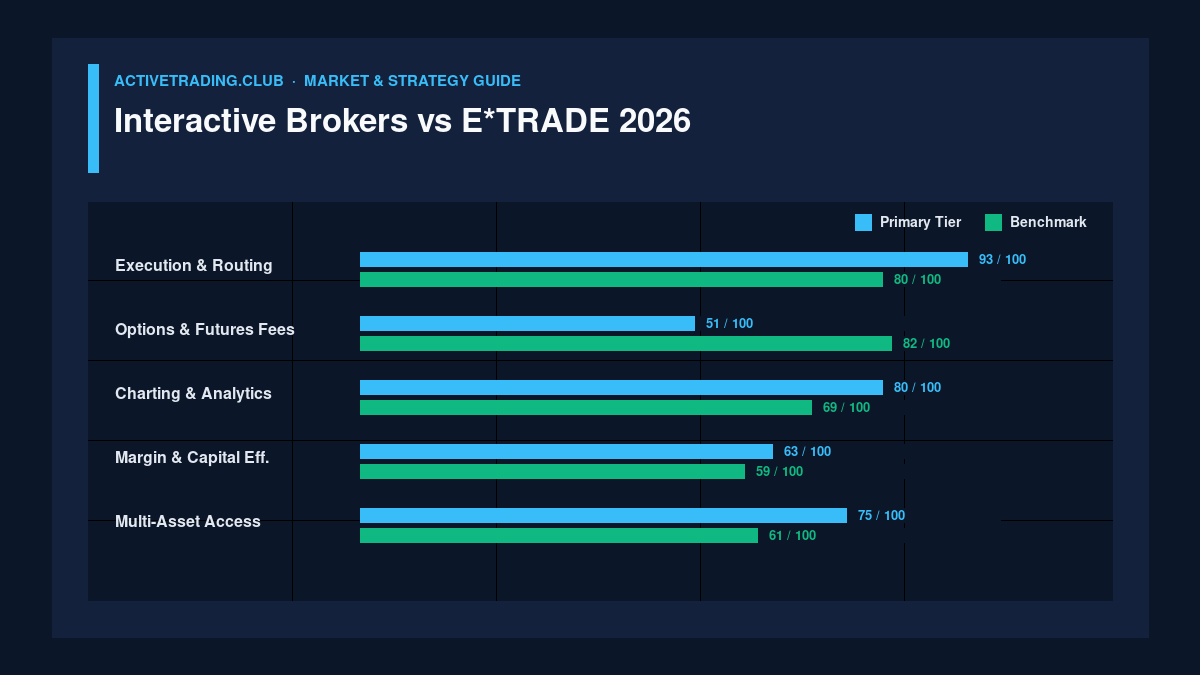
Interactive Brokers (IBKR) and ETRADE (E*TRADE) sit at opposite ends of the US brokerage spectrum. Interactive Brokers is the global professional platform: 150+ market centers, the cheapest mainstream futures commissions, benchmark-plus margin, and industrial-strength APIs. **ETRADE**, now part of Morgan Stanley, is the polished US retail brokerage: Power E*TRADE for options analysis, Morgan Stanley research, banking integration, and a gentle on-ramp from investing to active trading.
Below we compare both on verified October 2026 fee schedules, work through real options and futures cost math, and map each broker to the trader it actually fits.
Side-by-Side Comparison (Verified October 2026)
Fee data verified on 2026-10-19 against Interactive Brokers Commissions and the E*TRADE pricing page. Headline rates exclude exchange, clearing, OCC/NFA, and regulatory pass-through fees.
| Feature / Fee | Interactive Brokers (Visit IBKR) | E*TRADE (Visit E*TRADE) |
|---|---|---|
| Best For | Global multi-asset traders, futures scalpers, API/algo traders, margin users | US options and futures-curious traders who want a polished platform, Morgan Stanley research, and banking under one roof |
| Regional Availability | Global (150+ market centers; local entities, multi-currency funding) | US only (Morgan Stanley brokerage for US residents) |
| US Stocks & ETFs | $0 (IBKR Lite, US residents) / $0.005/share (Pro Fixed, $1.00 min) | $0 commission online |
| Equity/Index Options | $0.65/contract Fixed ($1.00 min/order); Tiered can run lower with rebates | $0.65/contract — $0.50 at 30+ trades/quarter; $0 exercise/assignment; Dime Buyback: $0 contract fee closing short options ≤$0.10 |
| Standard Futures | $0.85/contract/side (≤1,000/mo) → $0.65 / $0.45 / $0.25 tiered | $1.50/contract/side flat (no volume discount) |
| Micro Futures | $0.25/contract/side Fixed; $0.10–$0.25 Tiered | $1.50/contract/side — no micro discount (E-nano equity index futures: $0.75) |
| Futures Options | Same futures schedule (USD $0.85 entry tier) | $1.50/contract/side |
| Spot Crypto | 0.12%–0.18% of trade value ($1.75 min) via Paxos/Zero Hash | Advertised at 0.50% of trade value — check availability |
| Spot Forex | Yes — interbank spreads, ~$2 minimum | No (futures FX only) |
| Margin Rates | Benchmark rate + fixed spread (lowest among mainstream US brokers) | Standard tiered retail schedule — materially higher than IBKR |
| Flagship Platform | Trader Workstation (TWS), IBKR Desktop, IBKR Mobile | Power ETRADE (web/mobile options analytics + paper trading), ETRADE web |
| API / Automation | TWS API (Python/Java/C++), Client Portal REST/WebSocket, FIX | Limited — E*TRADE API covers market/account data and basic orders |
| Account Minimum | $0 | $0 |
New-account promotion (verified 2026-10-19): ETRADE advertises up to $1,500 cash credit for qualifying deposits with code OFFER26 — terms and deposit tiers apply; confirm on the pricing page.*
Real Trade Cost Math: Where Each Broker Wins

Scenario 1: Ten-Contract Options Round Trip (Low Volume)
- Interactive Brokers (Fixed):
10 × $0.65 × 2 sides= $13.00 round trip - E*TRADE (<30 trades/quarter): $13.00 round trip
- Wash — identical headline rates. IBKR’s $1.00 order minimum only bites below ~2 contracts.
Scenario 2: Same Trade at 30+ Trades/Quarter
- E*TRADE (preferred tier):
10 × $0.50 × 2= $10.00 round trip - Interactive Brokers (Fixed): $13.00 round trip
- Winner for US options volume: E*TRADE — 30 trades per quarter is roughly one round trip per week, a bar most active traders clear. Add the Dime Buyback ($0 contract fee closing short options worth ≤$0.10) and E*TRADE edges out IBKR Fixed for ordinary US options flow.
Scenario 3: Active Futures Trader (100 E-mini Sides / Month)
- Interactive Brokers:
100 × $0.85= $85.00/month - E*TRADE:
100 × $1.50= $150.00/month — no volume discount exists. - On Micro E-minis:
100 × $0.25= $25.00 at IBKR versus100 × $1.50= $150.00 at E*TRADE, which publishes no micro rate (only E-nano equity index futures get $0.75). - Winner for futures: Interactive Brokers — ~1.8× cheaper on standard contracts and 6× cheaper on micros. Futures costs alone justify IBKR for anyone trading them weekly.
Scenario 4: The International Trader
E*TRADE serves US residents only. A trader in Germany, the UK, or Singapore can’t open a standard account at all — IBKR is the default answer, with local entities, multi-currency funding at interbank-style FX spreads, and 150+ market centers. This single row of the table decides the comparison for most of our international audience.
Scenario 5: Margin-Borrowing Swing Trader
IBKR Pro’s benchmark-plus-spread margin pricing sits several percentage points below E*TRADE’s tiered retail schedule at typical debit balances — the recurring-cost gap compounds for anyone carrying leveraged positions overnight. Check both brokers’ margin pages for your exact tier.
Use the Broker Fee Calculator embedded on this page to model your exact monthly stock, options, and futures volume across all 10 brokers in our dataset.
Platform & Workflow: Power E*TRADE vs Trader Workstation

Why US Traders Like E*TRADE
- Power E*TRADE: clean options-chain and risk/reward visualization, easy multi-leg order entry, and built-in paper trading — the friendliest serious options platform in US retail.
- Morgan Stanley wrapper: research, analyst insights, banking, and full-service brokerage features that IBKR doesn’t try to match.
- Easy volume discount: the $0.50 options tier kicks in at just 30 trades per quarter — no monthly-tier mechanics.
- Trade-offs: US-residents only, flat $1.50 futures pricing with no micro rate, limited automation surface, and no spot forex.
Why Global and Systematic Traders Choose Interactive Brokers
- Market breadth: US, European, and Asian exchanges; spot FX; spot crypto; futures — all from one account.
- Execution depth: 100+ order types and algos (VWAP, TWAP, pegged, BookTrader DOM) on TWS/IBKR Desktop.
- APIs built for automation: mature Python/Java/C++/REST interfaces — the standard retail choice for systematic strategies.
- Lowest published futures and margin costs in this comparison, at entry level and at every tier.
- Trade-offs: TWS’s learning curve is real, research/education is thinner than E*TRADE’s Morgan Stanley stack, and the $1.00 options order minimum penalizes very small trades.
Who Should Choose Which Broker?
- Choose Interactive Brokers if:
- You trade futures or micros at any volume — the fee gap is structural, not promotional.
- You live outside the US, or want spot forex, spot crypto, and international markets in one account.
- You borrow on margin or build API-driven strategies.
- Choose E*TRADE if:
- You’re a US options trader clearing 30+ trades a quarter — $0.50/contract plus Dime Buyback beats IBKR’s flat fixed rate on plain-vanilla US flow.
- You want a friendly platform with paper trading, Morgan Stanley research, and banking in one login.
- You mostly trade US stocks/ETFs/options and don’t need futures at scale or international markets.
Compare the rest of the field — TradeStation, tastytrade, Schwab thinkorswim, Webull and more — in our Interactive Broker Finder, and size every trade before entry with the Position Size Calculator.
Frequently Asked Questions
Is Interactive Brokers or E*TRADE cheaper for options trading?
At low volume they tie: both charge $0.65 per contract, though IBKR Pro applies a $1.00 minimum per order. ETRADE drops to $0.50 per contract once you place 30+ trades per quarter — an easy threshold for active traders — and its Dime Buyback program waives the contract fee when you close short options priced at $0.10 or less. For US options traders clearing 30+ trades a quarter, ETRADE is marginally cheaper; traders needing global markets or tiered exchange-rebate pricing prefer IBKR.
Who has lower futures commissions — Interactive Brokers or E*TRADE?
Interactive Brokers by a wide margin. IBKR charges $0.85 per contract per side on standard USD futures at entry volume (tiered down to $0.25) and $0.25 per side on Micro E-minis. ETRADE charges a flat $1.50 per contract per side on futures and futures options regardless of volume, with no micro-contract discount (E-nano equity index futures excepted at $0.75). A 100-side month costs $85 at IBKR versus $150 at ETRADE.
Can non-US residents trade with E*TRADE?
Practically no — E*TRADE (from Morgan Stanley) is a US brokerage; its accounts are for US residents, with limited exceptions for certain existing expat clients. Interactive Brokers natively serves clients in 150+ countries with local entities and multi-currency funding, making it the default choice for international traders.
Which platform is better for active options trading — Power E*TRADE or Trader Workstation?
Power ETRADE is the easier platform: clean options chain views, a risk/reward analyzer, paper trading, and no learning curve. Trader Workstation offers far more order types, deeper global product access, and official APIs for automation, but takes real time to learn. US options traders who value usability often pick Power ETRADE; systematic and multi-market traders pick TWS or IBKR Desktop.
Does E*TRADE offer crypto trading?
E*TRADE advertises crypto trading at 0.50% of the dollar value of each trade on its 2026 pricing page — check current availability, as rollout details are still limited. Interactive Brokers offers established spot crypto trading at 0.12%–0.18% of trade value ($1.75 minimum) via Paxos/Zero Hash, plus crypto futures.
Related Reading
- TradeStation vs Interactive Brokers (2026) — the volume-tiered US alternative
- Interactive Brokers vs Schwab (thinkorswim) 2026
- Interactive Brokers vs tastytrade (2026)
- Broker Fee Calculator — model monthly commissions for your exact trade volume
Educational comparison only — not financial advice or a recommendation to open an account. Options and futures trading involves substantial risk of loss and is not suitable for every investor. Fee figures were verified against each broker’s official pricing schedule on October 19, 2026; always confirm current rates, fees, and regional availability on the broker’s website before funding an account.