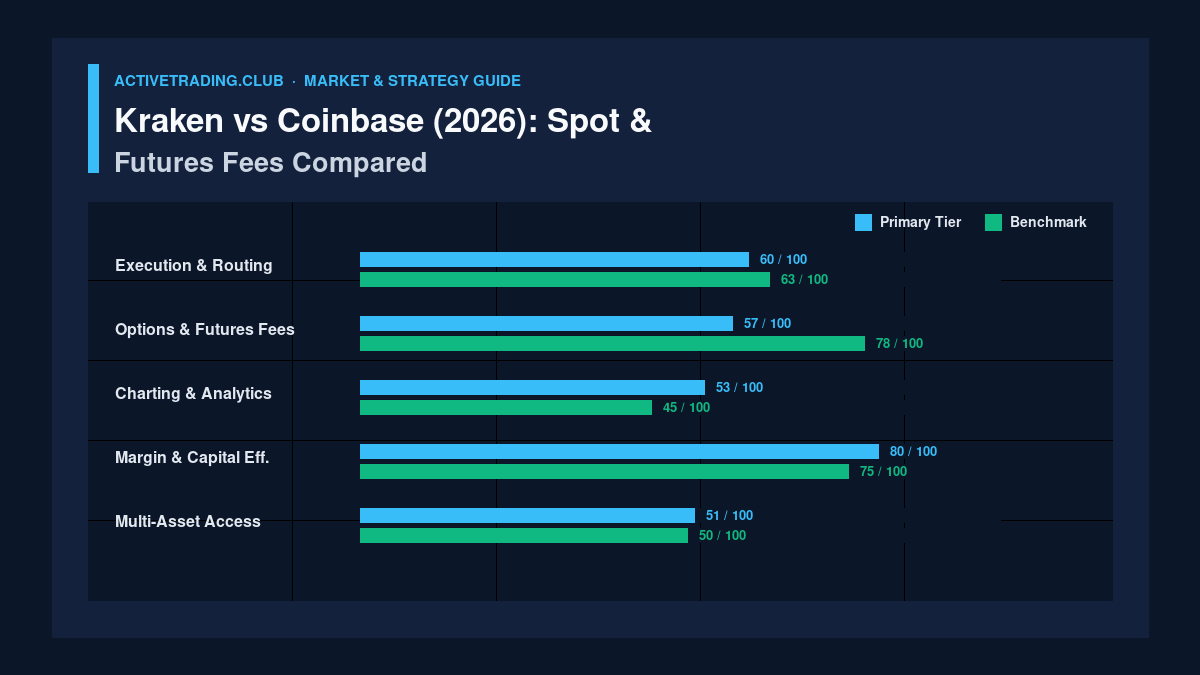
Kraken (Visit Kraken) and Coinbase (Visit Coinbase) are the two longest-standing fiat on-ramps most traders shortlist — and in 2026 both overhauled their fee schedules. Kraken switched to cross-platform tiers in July 2026 (your best of spot volume or assets on platform sets your rate), and Coinbase revised Advanced fees on September 16, 2026 with different entry rates per region. The headline answer changed with them.
Below we compare verified October 2026 fee schedules, run real cost math at different volumes and regions, and cover the futures products most comparisons skip.
Side-by-Side Comparison (Verified October 16, 2026)
Fee data verified on 2026-10-16 against the Kraken fee schedule, Kraken US futures fees, and Coinbase Advanced fees. Rates are headline retail tiers; always confirm the preview fee shown before each order.
| Feature / Fee | Kraken (Visit) | Coinbase (Visit) |
|---|---|---|
| Best For | Fee-sensitive active traders, futures/perp traders outside the US, low-cost US futures | Beginners wanting a simple on-ramp, US traders wanting a public-company exchange, EU/UK low-volume spot takers |
| Entry Spot Tier (30d vol < $2.5K) | 0.40% maker / 0.80% taker | US: 0.50% maker / 0.90% taker · EU/UK: 0.25% / 0.50% · other intl: 0.09% / 0.10% |
| ~$10K Monthly Volume | 0.22% / 0.38% (Tier 3; also reached with ~$20k assets on platform) | 0.35% / 0.75% (Advanced 1; USDC balance can also qualify) |
| ~$50K Monthly Volume | 0.15% / 0.30% (Tier 5) | 0.15% / 0.30% (Advanced 2 — identical) |
| ~$1M+ Monthly Volume | 0.06% / 0.18% (Tier 9) → 0% / 0.05% at Pro 5 | 0.06% / 0.10% (VIP 1) → 0% / 0.02% at VIP 8 |
| Tier Qualification | Best of: 30-day spot volume or Assets on Platform (AoP) | Best of: 30-day volume (spot / derivatives) or USDC balance |
| Simple / Instant Buys | Instant Buy: higher displayed fee, shown at preview — avoid for size | Simple trade: spread + flat fee — use Advanced instead |
| US Futures | CME-listed, flat per-contract: $0.39/side Micros (MES/MNQ), $1.29/side standard (ES/NQ) + exchange/NFA | CME-listed, flat per-contract commission (~$0.15/contract per published schedule) + exchange/NFA |
| Perp Futures (non-US) | 0.02% maker / 0.05% taker entry; negative maker rebates at top tiers | 0.095% maker / 0.10% taker entry tier on derivatives |
| Markets | Advertises 1,400+ spot pairs on Kraken Pro | Advertises 500+ spot pairs on Advanced; 22 stablecoin pairs at 0% maker |
| Structure | Private exchange, founded 2011 | NASDAQ-listed public company (COIN) |
Real Cost Math: Who Pays Less?

Crypto fee comparisons fall apart without a region and a volume assumption — the 2026 schedules made that especially true here.
Scenario 1: $1,000 Taker Market Buy, US Resident, Entry Tier
- Kraken Pro:
$1,000 × 0.80%= $8.00 - Coinbase Advanced (US):
$1,000 × 0.90%= $9.00 - Winner: Kraken by $1 — but both lose badly to the maker rate (see below).
Scenario 2: Same Trade, EU/UK Resident
- Kraken Pro: $8.00 (global unified tiers)
- Coinbase Advanced (EU/UK entry):
$1,000 × 0.50%= $5.00 - Winner: Coinbase — its post-September-2026 regional pricing gives EU/UK low-volume takers a cheaper entry rate.
Scenario 3: $10,000/Month Spot Volume (Taker)
- Kraken Tier 3:
0.38%→ $38/month per $10k traded - Coinbase Advanced 1:
0.75%→ $75/month per $10k traded - Winner: Kraken, by nearly half. This mid-volume band is where Kraken’s schedule separates — and holders of ~$20k in assets qualify for Tier 3 without trading at all.
Scenario 4: $1M+/Month Volume (Taker)
- Kraken Tier 9:
0.18%; Coinbase VIP 1:0.10% - Winner: Coinbase — at the top of the retail curve its taker rates undercut Kraken’s until the $10M+ tier, and makers on both hit 0% by the top tiers.
Scenario 5: Micro Bitcoin/Ether Futures, US (100 sides of MES)
- Kraken Derivatives US:
100 × $0.39= $39 + exchange/NFA - Coinbase: flat per-contract commission (~$0.15 published) + exchange/NFA
- Winner: Coinbase on published commission — its US per-contract rate is the cheaper headline for micro contracts, while Kraken’s non-US perp maker/taker schedule (0.02%/0.05%) is the cheaper instrument where it’s offered.
The One Rule That Matters More Than the Venue

Both exchanges operate two fee universes: the simple/instant buy flow (spread + flat/convenience fee, the most expensive way to trade on either platform) and the advanced order book (Kraken Pro / Coinbase Advanced), where the published maker/taker tables apply. Nothing else in this comparison matters if you’re still paying simple-trade pricing — switch interfaces first, then compare tiers.
For leveraged perp positions, the trading fee is only half the drag — funding payments often cost more over a multi-day hold. Model that with our Funding Rate Calculator and check liquidation levels before sizing in with the Liquidation Calculator.
Who Should Choose Which Exchange?
- Choose Kraken if:
- You’re a US trader doing $10K–$1M/month — the mid-tier taker rates are materially cheaper.
- You hold meaningful assets on-platform and want the AoP shortcut to lower tiers without volume.
- You trade non-US perpetual futures (0.02%/0.05% entry is hard to beat) or want a unified spot+perp venue.
- Choose Coinbase if:
- You’re an EU/UK or other international trader at low volume (0.25%/0.50% or 0.09%/0.10% entry beats Kraken’s 0.40%/0.80%).
- You trade $1M+/month and qualify for VIP taker rates (0.10% vs Kraken’s 0.18%).
- You want a publicly traded US venue, the simplest on-ramp for a first buy, or micro US futures at a low flat per-contract rate.
If you trade both crypto and equities, some multi-asset brokers now offer spot crypto alongside futures and stocks — see our Interactive Brokers vs tastytrade and Interactive Brokers vs Schwab comparisons, or filter all 10 brokers in the Broker Finder.
Frequently Asked Questions
Which is cheaper for buying $1,000 of Bitcoin — Kraken or Coinbase?
On the advanced order-book interfaces (Kraken Pro, Coinbase Advanced), it depends on your region and order type. US traders at entry tier pay 0.80% taker ($8.00) on Kraken versus 0.90% ($9.00) on Coinbase Advanced, while EU/UK traders pay 0.50% ($5.00) on Coinbase versus 0.80% ($8.00) on Kraken. Using a resting limit order pays the maker rate instead — 0.40% Kraken, 0.50% Coinbase US. Avoid both platforms’ simple/instant buy flows, which cost meaningfully more.
Does Kraken or Coinbase have lower futures fees?
They sell different futures products. US clients trade CME-listed contracts on flat per-contract commissions — Kraken publishes $0.39/side on Micro contracts (MES/MNQ) and $1.29/side on standard contracts (ES/NQ) plus exchange and NFA fees. Coinbase US-listed futures carry a flat per-contract commission plus exchange/NFA fees (its published schedule lists ~$0.15/contract). Outside the US, Kraken perpetual futures start at 0.02% maker / 0.05% taker, and Coinbase’s derivatives tiers start at 0.095% maker / 0.10% taker.
Can I lower my fees with limit orders?
Yes — resting limit orders that add liquidity pay the maker rate, which is roughly half the taker rate at entry tier on both exchanges (Kraken 0.40% vs 0.80%; Coinbase Advanced US 0.50% vs 0.90%). Coinbase also charges 0% maker fees on 22 stablecoin pairs, and both exchanges cut rates sharply as 30-day volume (or qualifying asset balances) grows.
Which exchange is better for beginners?
Coinbase’s simple interface is easier for a first purchase, but its simple trade flow bundles a spread plus a flat fee that is far more expensive than its Advanced order book. Kraken’s Instant Buy has the same problem. Whichever you choose, learn the Pro/Advanced interface — that is where the published maker/taker fees apply.
Are Kraken and Coinbase both regulated?
Coinbase is a US publicly traded company (NASDAQ: COIN) regulated in the US and licensed in multiple jurisdictions. Kraken is a private US-founded exchange (2011) operating under licenses in the US, EU, UK and other markets. Both publish regulatory details on their websites — verify the entity serving your country before depositing.
Related Reading
- Funding Rate Calculator — estimate what leveraged perp positions cost to hold
- Liquidation Calculator — find your liquidation price before entering
- Understanding the Crypto Basis Trade: Spot vs Futures
- Understanding Funding Rates and Volatility
Educational comparison only — not financial advice. Crypto assets are volatile and trading them — especially with leverage — involves substantial risk of loss. Fee figures verified against each exchange’s official fee schedule on October 16, 2026; tiers, regional rates, and product availability change, so always confirm the fee shown in your order preview before trading.