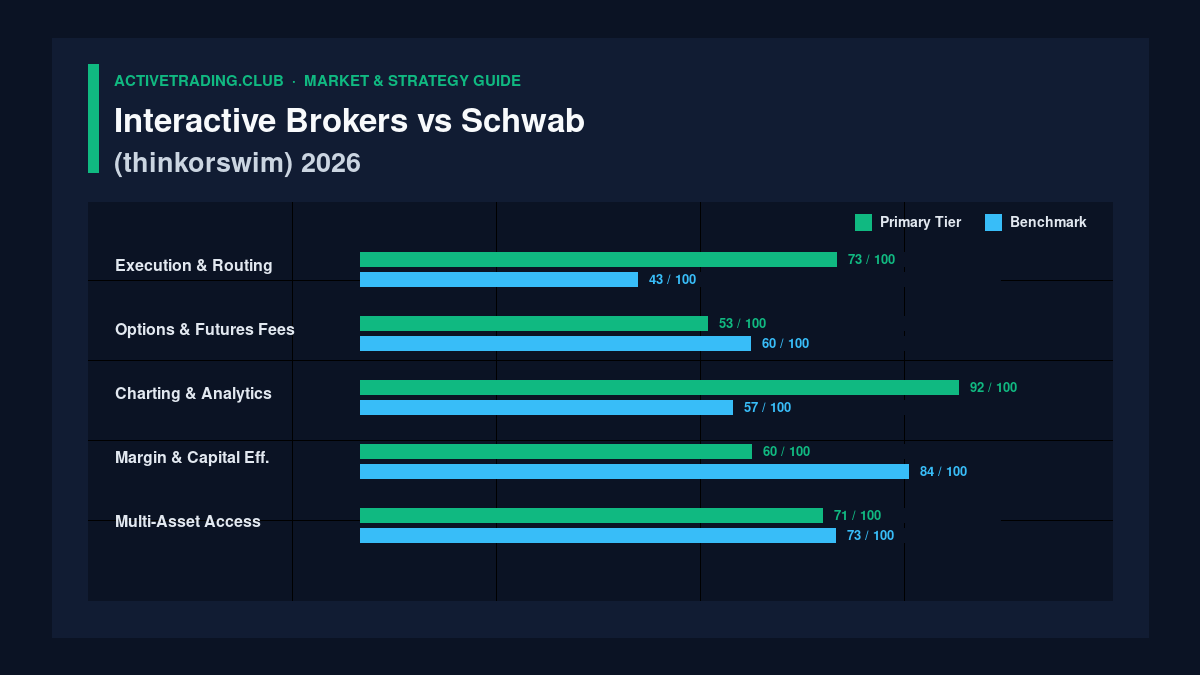
Interactive Brokers (IBKR) and Charles Schwab (Schwab) are the two names that come up in almost every serious “which broker” thread — but they are built for different traders. Interactive Brokers is a global, multi-asset execution platform: 150+ market centers, rock-bottom margin rates, and institutional-style APIs. Charles Schwab is a US full-service brokerage whose killer feature for active traders is thinkorswim — the pro-grade platform it inherited from TD Ameritrade — plus deep research, education, and branch-level support.
Below we compare both brokers on verified October 2026 fee schedules, work through real options and futures cost math, and map each platform to the trading styles it actually fits.
Side-by-Side Comparison (Verified October 2026)
Fee data verified on 2026-10-05 against Interactive Brokers Commissions and Schwab Pricing. Headline rates exclude exchange, clearing, OCC, and regulatory pass-through fees.
| Feature / Fee | Interactive Brokers (Visit IBKR) | Charles Schwab (Visit Schwab) |
|---|---|---|
| Best For | Global multi-asset traders, futures scalpers, API/algo traders, margin users | US traders who want a pro-grade free platform, research, education, and full-service support |
| Regional Availability | Global (150+ market centers; local entities and EUR/GBP/USD funding) | US primary (limited international account with higher funding minimum) |
| US Stocks & ETFs | $0 (IBKR Lite, US) / $0.005/share (IBKR Pro Fixed, $1.00 min) | $0 commission online |
| Equity Options Commission | $0.65 / contract ($1.00 minimum per order, charged open and close; lower at volume on Tiered) | $0.65 / contract (no base fee, no order minimum) |
| Standard Futures (E-mini) | $0.85 / contract / side (+ exchange/NFA fees) | $2.25 / contract / side (+ exchange/NFA fees) |
| Micro Futures | $0.25 / contract / side (+ exchange/NFA fees) | $2.25 / contract / side — no discounted micro rate on the published schedule |
| Spot Crypto | 0.12%–0.18% of trade value ($1.75 min) via Paxos/Zero Hash | No (crypto exposure via ETFs/ETPs only) |
| Spot Forex | Yes (institutional interbank spreads, ~$2 minimum) | Limited (forex futures on thinkorswim; spot FX offering is narrower) |
| Flagship Platform | Trader Workstation (TWS), IBKR Desktop, IBKR Mobile, TWS/REST API | thinkorswim Desktop, Web, and Mobile (free for all Schwab clients) |
| Research & Education | Functional; Traders’ Academy courses, limited third-party research | Strong — Schwab research, in-platform education, live coaching/webcasts on thinkorswim |
| Account Minimum | $0 | $0 |
Real Trade Cost Math: Where Each Broker Wins

Headline per-contract rates look identical on options — both publish $0.65 — but the order minimum, the tiered pricing option, and the futures gap decide the real winner.
Scenario 1: Single-Contract Options Round Trip
- Interactive Brokers Pro: $1.00 to open (the $1.00 order minimum applies) + $1.00 to close = $2.00 round trip
- Charles Schwab: $0.65 to open + $0.65 to close = $1.30 round trip
- Winner at 1 contract: Schwab — IBKR’s per-order minimum makes 1-lot options trades proportionally expensive.
Scenario 2: Ten-Contract Options Round Trip
- Interactive Brokers Pro (Fixed):
10 × $0.65 = $6.50to open +$6.50to close = $13.00 round trip - Charles Schwab: $13.00 round trip
- Wash on the Fixed plan — but IBKR’s Tiered plan starts below $0.65/contract at higher monthly volumes and passes through exchange rebates on liquidity-adding orders, so heavy options traders can come out ahead at IBKR.
Scenario 3: Active Futures Trader (100 E-mini Sides / Month)
- Interactive Brokers:
100 × $0.85= $85.00 / month in broker commissions - Charles Schwab:
100 × $2.25= $225.00 / month in broker commissions - On Micro E-minis, the gap is extreme:
100 × $0.25= $25.00 at IBKR versus100 × $2.25= $225.00 at Schwab, which lists no discounted micro rate on its published schedule. - Winner for futures: Interactive Brokers — roughly 2.6× cheaper on standard contracts and ~9× cheaper on micros before exchange fees.
Scenario 4: Margin-Borrowing Swing Trader
Both brokers publish margin schedules, but their structures differ: IBKR Pro charges a benchmark rate plus a fixed spread in tiers, which consistently lands well below standard retail margin pricing, while Schwab uses a fixed tiered schedule typical of full-service brokers. If you regularly hold leveraged positions overnight, IBKR’s margin cost advantage is material — check both brokers’ current margin pages for the exact rate on your balance tier.
Use the Broker Fee Calculator embedded on this page to model your exact monthly stock, options, and futures volume across all 10 brokers in our dataset.
Platform & Workflow: thinkorswim vs Trader Workstation

Why US Traders Love Schwab’s thinkorswim
Since the TD Ameritrade account migration completed in 2023–24, thinkorswim is Schwab’s flagship platform — free for every client, no volume requirements:
- Pro-grade options analytics: the Analyze tab’s risk-profile graphs, Greeks, and probability tools remain the retail benchmark for visualizing multi-leg positions (see our TradingView vs thinkorswim comparison).
- paperMoney: a full simulated account for testing strategies before risking capital.
- Full-service wrapper: Schwab adds research reports, in-platform education and webcasts, 24/7 support, physical branches, banking, and fractional-share Stock Slices — none of which IBKR matches at retail level.
- Trade-offs: futures commissions are high, there is no spot crypto, forex breadth is narrower, and the account is fundamentally US-centric.
Why Global and Systematic Traders Choose Interactive Brokers
- Global market access: trade US, European, and Asian exchanges from one account with local-currency funding and spot FX conversion at interbank-style spreads.
- Execution and order types: TWS/IBKR Desktop support 100+ order types and algos (VWAP, TWAP, pegged orders, BookTrader DOM).
- API ecosystem: mature Python/Java/C++/REST APIs make IBKR the default retail broker for automated strategies.
- Lowest headline futures and margin costs of the mainstream brokers we track.
- Trade-offs: classic TWS has a steep learning curve; research and hand-holding are thinner than Schwab’s; the $1.00 options order minimum penalizes very small trades.
Who Should Choose Which Broker?
- Choose Interactive Brokers if:
- You live outside the US, or you trade international markets, spot FX, futures (especially Micros), or crypto alongside equities.
- You run API-driven or algorithmic strategies, or you borrow on margin overnight.
- You trade futures actively — the $0.85/$0.25-vs-$2.25 gap compounds fast.
- Choose Charles Schwab if:
- You are a US trader who wants thinkorswim’s options analytics and paperMoney free with no volume requirement.
- You value research, education, phone/branch support, and banking under one roof.
- You trade mostly US stocks, ETFs, and small-to-mid options orders where the flat $0.65/no-minimum schedule is competitive.
Compare the rest of the field — TradeStation, tastytrade, E*TRADE, Webull and more — in our Interactive Broker Finder, and size every trade before entry with the Position Size Calculator.
Frequently Asked Questions
Is Interactive Brokers or Charles Schwab cheaper for options trading?
Both publish a $0.65-per-contract headline rate on equity options, but the details differ. Interactive Brokers Pro applies a $1.00 minimum per order, so a single-contract round trip costs $2.00 versus $1.30 at Schwab. At higher volume, IBKR’s Tiered plan can drop below $0.65 and liquidity-adding orders may earn exchange rebates, while Schwab stays at a flat $0.65 per contract with no base fee and no order minimum.
Which platform is better for day trading — thinkorswim or Trader Workstation?
thinkorswim (now Schwab’s platform after the TD Ameritrade migration) is free, includes paperMoney simulated trading, and is especially strong for options analytics and charting. Trader Workstation offers more order types, deeper global market access, BookTrader DOM ladders, and official APIs for automation. Pure US-market options day traders often prefer thinkorswim; multi-asset, international, and algorithmic traders usually prefer TWS or IBKR Desktop.
Can non-US residents open a Charles Schwab account?
Charles Schwab is primarily a US brokerage. Its international account option exists for select countries but carries a higher published funding minimum and a reduced product set compared with the US offering. Interactive Brokers natively serves clients in 150+ countries with local regulatory entities and local-currency funding in EUR, GBP, and more, making it the default choice for most non-US traders.
Who has lower futures commissions — Schwab or Interactive Brokers?
Interactive Brokers, clearly. Schwab’s published futures commission is $2.25 per contract per side, and its pricing page does not list a discounted rate for Micro contracts. Interactive Brokers charges $0.85 per side on standard contracts and $0.25 per side on Micro E-minis (before exchange and NFA fees), so a trader doing 100 standard sides a month pays roughly $85 at IBKR versus $225 at Schwab in commissions.
Does Charles Schwab offer an API for algorithmic trading?
Schwab provides a Trader API (inherited and rebuilt from TD Ameritrade) that supports account data and order placement, but its ecosystem and documentation for systematic trading are younger and narrower. Interactive Brokers offers mature Python, Java, C++, and REST/WebSocket APIs and is the standard retail choice for automated and algorithmic strategies.
Related Reading
- Broker Fee Calculator — model monthly commissions for your exact trade volume
- Interactive Brokers vs tastytrade (2026) — the other active-trader showdown
- TradingView vs thinkorswim: Which Platform Is Better?
- Best Trading Platforms for Beginners (2026)
Educational comparison only — not financial advice or a recommendation to open an account. Options and futures trading involves substantial risk of loss and is not suitable for every investor. Fee figures were verified against each broker’s official pricing schedule on October 5, 2026; always confirm current rates, exchange fees, and regional availability on the broker’s website before funding an account.