The Top 5 Mistakes New Traders Make and How to Avoid Them
New traders often struggle not because they lack the right indicators, but due to an ineffective approach to the market. Early losses frequently stem from poor risk management, emotional decision-making, and unrealistic expectations, rather than a deficiency in technical skills. Addressing a few key mistakes can lead to improved trading results more quickly than learning additional strategies.
Here are five common mistakes I see among new traders, along with practical solutions to help avoid them.
1. Trading Without a Real Plan
Many beginners enter trades based on gut feelings rather than a structured plan. They may recognize a chart pattern but lack a well-defined strategy to follow when real money is at stake. This often results in impulsive entries, inconsistent trade sizes, and emotional exits.
A trading plan should serve as a comprehensive guide rather than a motivational tool. It should clearly outline:
- The market or setup you intend to trade
- The timeframes you will use
- Entry criteria
- Stop-loss placement
- Risk tolerance
- Profit-taking strategies
- Conditions that prompt you to refrain from trading
Example
Consider a new trader who buys a stock breaking out at $48 simply because it appears strong. When the price dips to $47.20 shortly after, they panic and sell. Later, the stock rebounds to $49.50. The issue wasn’t the stock; it was the absence of a solid plan.
How to Avoid It
- Draft a concise trading plan.
- Focus on a single setup.
- Clearly define your entry trigger.
- Establish your stop-loss prior to entering the trade.
- Determine your target or exit strategy.
- Identify circumstances when you won’t trade.
- Review your plan before each trading session.
Practical Rule
If you cannot summarize your trade setup in one sentence before entering, it’s likely you don’t have a well-defined strategy.
2. Risking Too Much on a Single Trade

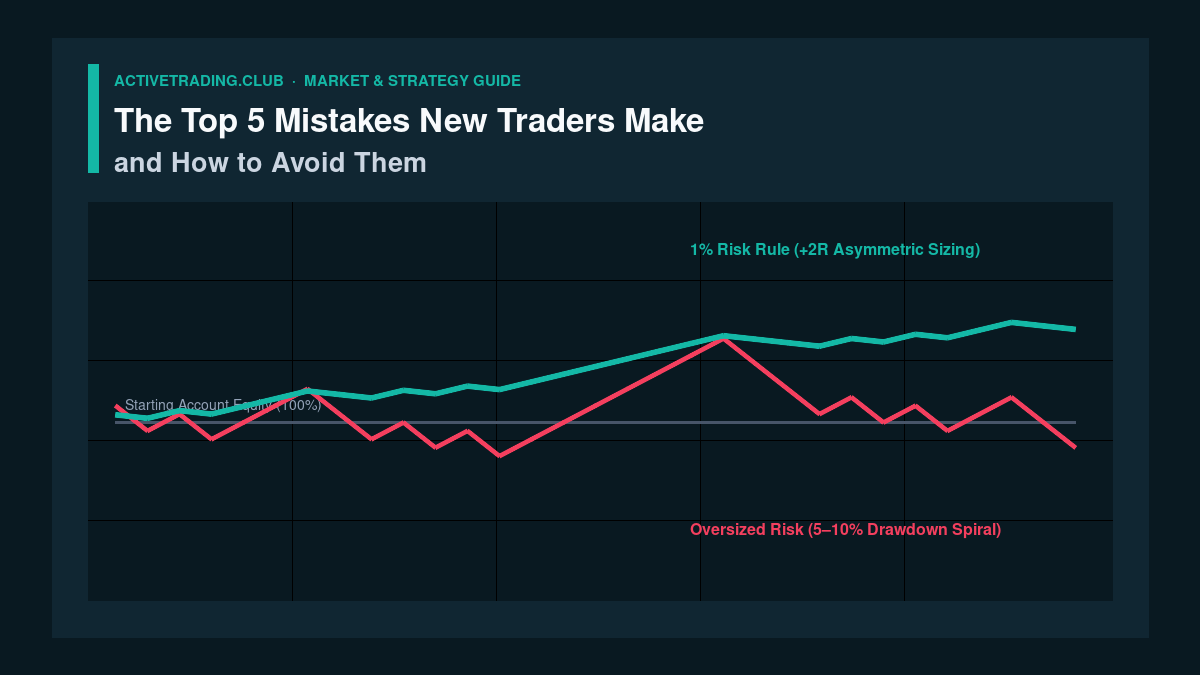
A common pitfall for beginner traders is focusing on potential gains rather than possible losses. This mindset can lead to oversized positions and significant emotional stress. A single poor trade can have a detrimental impact if the position size is too large.
Regulatory bodies consistently caution that day trading carries a high risk and can lead to substantial losses, particularly for those new to the practice. This warning should not be taken lightly.
Example
Imagine you have a $10,000 trading account and decide to risk $1,000 on a trade because you believe strongly in the setup. If the trade goes against you, that represents a 10% loss, which is much harder to recover from than many new traders realize.
Better Approach: Fixed Risk Per Trade
Professional traders often risk a small, fixed percentage of their account on each trade, typically around 0.5% to 1%, adjusting based on volatility and experience.
Step-by-Step Sizing Example
- Determine your maximum loss per trade.
- Set your stop-loss level.
- Measure the distance from entry to stop.
- Calculate position size to keep dollar losses within your limit.
Example:
- Account size: $10,000
- Risk per trade: 1% = $100
- Entry: $50
- Stop: $49
- Risk per share: $1
- Position size: 100 shares
If the stop is hit, the loss is around $100, which is manageable. If the trade is successful, the potential upside can exceed the downside.
Practical Rule
Always base your position size on your stop distance and predetermined risk limit, not on your excitement about the trade.
3. Ignoring Stop-Losses
Many novice traders either neglect to use stop-loss orders or fail to implement them correctly. Some place stops too close in an effort to avoid losses, while others refuse to honor them, hoping for a reversal. Both practices can lead to significant losses.
A stop-loss isn’t a foolproof protective measure; it simply marks the point at which your trade hypothesis is no longer valid.
Example
If you buy a breakout at $25.50, your thesis is invalidated if the price falls below $25.10 and remains there. Holding onto the position in hopes of a bounce deviates from your trading plan and shifts into gambling.
How to Avoid It
- Set your stop-loss before entering a trade.
- Ensure your stop-loss is based on logical criteria, not emotions.
- Base your stop on market structure or volatility, rather than a fixed dollar amount.
- Accept stops as a necessary part of trading.
- Avoid widening your stop to avoid taking a loss.
Good Stop Placement
An effective stop-loss is typically placed where your trade idea no longer holds. For a breakout, this might be just below the breakout level. For a trend pullback, it may be below the last swing low.
Poor Stop Placement
A poor stop is often set wherever feels comfortable, such as a fixed distance away, regardless of market dynamics.
Practical Rule
If your stop is too close to the current price and is frequently hit, it may need to be adjusted. If you find yourself moving it each time the price approaches, it may not serve its intended purpose.
4. Letting Emotions Run the Trade
Many new traders believe their main issue lies with their strategy, but the underlying problem is often emotional behavior. Fear, greed, impatience, and revenge trading can erode accounts more than poor chart analysis.
A common cycle includes:
- A small win boosts confidence.
- The trader increases position sizes too quickly.
- Losses become larger.
- They attempt to recover losses immediately.
- Overtrading ensues, leading to further losses.
This cycle can be destructive, as it often feels productive while only causing damage.
Example
A trader may lose $200 in the morning. Instead of stopping, they dive into several trades to recover those losses, losing sight of their strategy.
How to Avoid It
- Set a maximum daily loss limit.
- Cease trading once that limit is reached.
- Take breaks after significant wins.
- Reduce position sizes when feeling frustrated or fatigued.
- Avoid trading when distracted.
- Maintain a journal that tracks not only trades but also emotions.
Emotional Checkpoint
Before entering each trade, ask yourself:
- Am I calm?
- Am I adhering to my setup?
- Am I trying to recover losses?
- Am I forcing trades?
If the answer to the last two questions is yes, it may be time to step away.
Practical Rule
If you feel a sense of urgency, it’s likely you’re not seeing the market clearly.
5. Overtrading and Chasing Action
New traders often mistakenly believe that more trades equal more opportunities. In reality, overtrading can lead to more mistakes. This behavior often arises from a need to “do something” instead of waiting for quality setups.
The market rewards patience and selectivity, not constant activity.
Example
A trader may have a strategy that excels with high-volume breakouts. Instead of waiting for those conditions, they take multiple trades on small intraday movements, leading to a series of mediocre trades rather than one strong one.
Why Overtrading Occurs
- Boredom
- Fear of missing out
- Desire to recover losses
- The misconception that frequency leads to an advantage
- Lack of confidence in their strategy
How to Avoid It
- Clearly define what constitutes a valid trade.
- Focus solely on your best setups.
- Implement a trade checklist.
- Limit the number of trades per day.
- Review missed setups separately from executed trades.
Trade Checklist Example
Before entering a trade, verify:
- The trend or range is clear
- Volume supports the move
- The entry trigger is present
- The stop-loss is logical
- The reward-to-risk ratio is favorable
- The setup aligns with your plan
If any major condition is absent, it’s best to refrain from trading.
Practical Rule
Successful traders often find themselves bored, while those who struggle tend to be overly busy.
A Simple Framework to Trade Better Immediately

For new traders, it’s crucial not to attempt to rectify all issues at once. Start with a basic framework and gradually build from there.
Step 1: Pick One Market
Select one instrument or market type:
- Large-cap stocks
- ETFs
- Futures
- Forex
- Options (if you understand them)
Focusing on too many markets can create noise and confusion.
Step 2: Choose One Setup
Some examples include:
- Breakout
- Pullback in trend
- Opening range breakout
- Reversal at support/resistance
Starting with one setup is sufficient.
Step 3: Define Risk
- Risk a fixed percentage per trade
- Establish a maximum daily loss
- Set a maximum weekly loss
This approach helps you stay in the game long enough to learn.
Step 4: Keep a Journal
Document:
- Entry
- Exit
- Setup
- Rationale for the trade
- Size
- Outcome
- Emotional state
- Mistakes made
A journal transforms random experiences into valuable feedback — a spreadsheet works to start, while dedicated trading journal apps import fills automatically and compute the statistics for you.
Step 5: Review Weekly
At the end of each week, reflect on:
- Which setups performed best?
- What recurring errors were noted?
- Did I stick to my plan?
- Was the issue with strategy or discipline?
Failing to review means you are essentially paying tuition without taking notes.
Real-World Example: A Beginner Day Trader’s Progression
Here’s how a new trader might improve by addressing these five common mistakes.
Month 1: No Plan
- Trades anything that moves
- Sizes trades randomly
- Holds onto losing positions for too long
- Overtrades out of boredom
- Account balance declines rapidly
Month 2: Basic Structure
- Trades only one setup
- Risks 1% per trade
- Utilizes a stop-loss consistently
- Stops trading after reaching a daily loss limit
- Experiences fewer trades and smaller losses
Month 3: Improved Execution
- Maintains a trade journal
- Identifies that best results stem from morning breakouts
- Eliminates low-quality trades
- Achieves greater consistency
The key takeaway is not that they became an expert trader, but that they stopped making avoidable errors.
What New Traders Should Focus On First
To survive and improve, prioritize the following in order:
- Risk management
- Trade selection
- Execution discipline
- Journaling
- Strategy refinement
This order is important; a sound strategy with poor risk management is likely to fail, while a simple strategy combined with strong discipline can sustain you long enough to develop.
A Few Hard Truths Worth Hearing
- Day trading is highly risky, and many traders incur losses, particularly in the beginning.
- Leverage can amplify both gains and losses, making mistakes more costly.
- Quick profits are not typical.
- No indicator can correct poor trading habits.
- Ultimately, the onus of discipline lies with the trader.
If this sounds blunt, that’s intentional. New traders benefit from structure rather than unrealistic expectations.
Final Takeaway
The five most common mistakes made by new traders are straightforward:
- Trading without a plan.
- Risking too much on trades.
- Ignoring stop-losses.
- Allowing emotions to dictate trades.
- Overtrading.
The solution is equally clear:
- Establish rules.
- Maintain small position sizes.
- Utilize stop-loss orders.
- Manage your emotional state.
- Focus on quality trades, not quantity.
These practices will help you minimize losses and build a sustainable trading process.
This article may contain affiliate links.