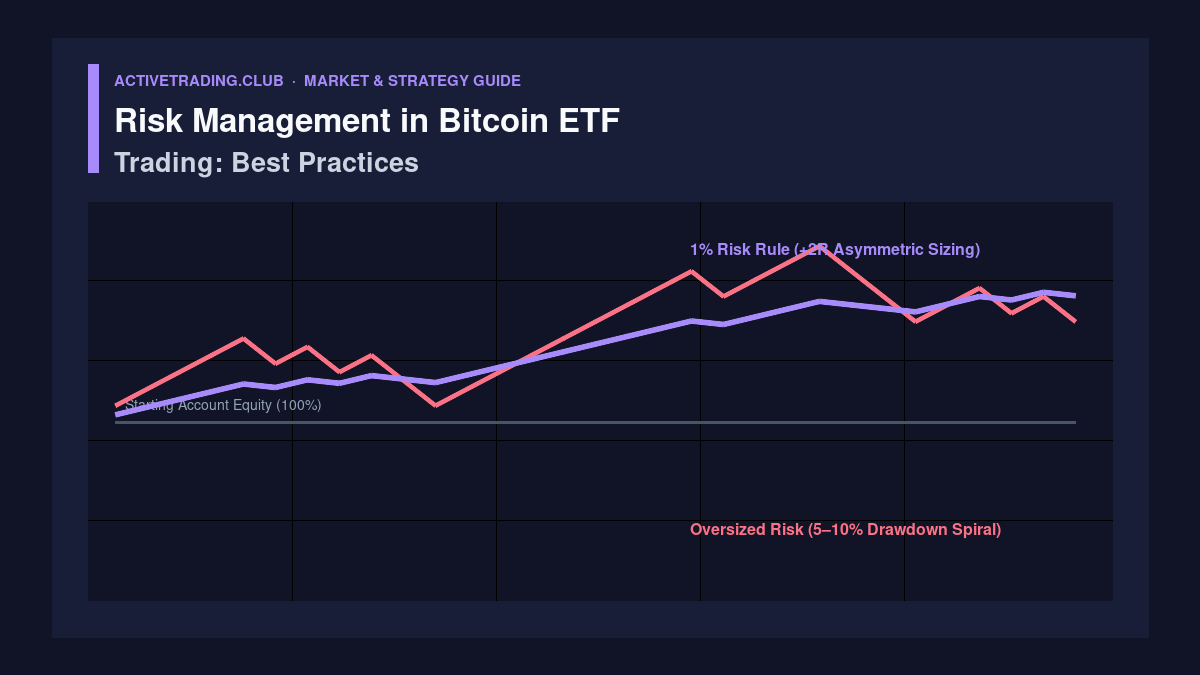
Risk Management in Bitcoin ETF Trading: Best Practices
Trading Bitcoin ETFs can appear more straightforward than purchasing spot bitcoin on a crypto exchange; however, the risks associated with these products remain significant. The price of Bitcoin is still subject to considerable volatility, spreads can widen unexpectedly, fees are an important consideration, and the ETF structure introduces unique execution and liquidity challenges. The prospectuses for Bitcoin-related ETFs consistently highlight that Bitcoin is speculative and can lead to substantial or even total losses.
For active traders, the key to success is not merely in making predictions but in effectively managing risk, sizing positions appropriately, and understanding both the advantages and limitations of the ETF structure. This is particularly crucial in Bitcoin ETFs, as they tend to attract both long-term investors and short-term momentum traders.
Understanding the Unique Risk Framework for Bitcoin ETFs
A Bitcoin ETF is more than just “Bitcoin in a wrapper.” It operates as a listed security with specific trading hours, bid-ask spreads, sponsor fees, and creation/redemption mechanics. SEC filings for these funds emphasize that the fund’s value can fluctuate with Bitcoin, and that valuation, liquidity, and regulatory factors are central risks.
Traders face risk from four primary layers:
- The underlying asset: Bitcoin’s inherent price volatility.
- The ETF structure: Fees, tracking, spreads, and liquidity.
- Market conditions: Macro events, sentiment in the crypto space, and trading patterns in the U.S. market.
- Individual execution: Issues like poor entry points, oversized positions, and ineffective stop placements.
Neglecting any of these layers can lead to an incomplete trading plan.
Key Risks to Manage

1. Bitcoin Volatility
Bitcoin remains one of the most volatile large assets in public markets. ETF disclosures label Bitcoin as speculative, noting the potential for substantial losses. This volatility can result in significant price gaps, rapid trend reversals, and challenging intraday swings.
Practical implications:
- Position sizes for Bitcoin ETFs should not match those for more stable assets like utility stocks.
- Be mindful that stop orders can slip during fast-moving markets.
- Exercise extreme caution when using leverage, particularly with leveraged Bitcoin funds.
2. Tracking and Structure Risk
While Bitcoin ETFs are designed to track Bitcoin, they do not mirror direct ownership. The performance of these ETFs can be influenced by fund expenses, cash drag, and market microstructure. SEC materials also highlight valuation and liquidity concerns.
Practical implications:
- Regularly compare the ETF’s performance against Bitcoin’s price movement during your trading period.
- Monitor whether the fund is trading close to its net asset value (NAV) and watch for widening spreads.
- Utilize limit orders rather than market orders, especially in thin liquidity conditions.
3. Liquidity Risk
Liquidity extends beyond average trading volume; it encompasses the ability to enter or exit a position when desired. The ETF market can vary significantly in liquidity, impacting execution quality. Currently, funds such as IBIT and BTC rank highly in terms of liquidity, whereas smaller funds may have worse spreads and higher trading costs.
Practical implications:
- A seemingly “cheap” ETF can become costly if the spread is wide.
- Smaller funds might be suitable for long-term holds, but can be detrimental for active trading.
- On volatile days, spreads can exceed the expense ratio.
4. Fee Drag
Expense ratios can have a more pronounced effect than many traders acknowledge, particularly for swing traders or those holding positions for extended periods. Fee comparisons reveal that costs for spot Bitcoin ETFs vary by issuer, with some around 0.15%-0.25%, and temporary waivers potentially lowering effective costs.
Practical implications:
- For short-term trades, fees may be secondary to execution quality.
- For longer-term positions, even small fee differences can accumulate significantly.
- Avoid chasing zero-fee promotions if the fund is illiquid or has a wide spread.
5. Regulatory and Headline Risk
While Bitcoin ETFs operate within a regulatory framework, Bitcoin itself faces ongoing scrutiny and changing policies. SEC filings indicate that the agency has not claimed the same regulatory authority over Bitcoin as it has over traditional securities, making the treatment of Bitcoin under federal laws a matter of discussion.
Practical implications:
- Be prepared for sudden volatility triggered by regulatory news.
- Limit exposure before major policy announcements unless your trading plan accounts for it.
- Do not mistake ETF approval for the elimination of risks.
Best Practices for Risk Management
1. Define Your Trade Horizon
One common mistake traders make is applying the same risk rules across different trading styles, such as scalping, swing trading, and long-term investing. Bitcoin ETFs can serve all three purposes, but the risk management strategies should differ.
Framework:
- Intraday trade: Focus on spread, volatility, and effective stop execution.
- Swing trade: Concentrate on structure, trend quality, and gap risks.
- Investment position: Consider fees, tax implications, and position sizing.
If you cannot articulate your time horizon, your risk plan needs further development.
2. Size Positions Based on Volatility
Position sizing should be dictated by volatility rather than confidence.
Practical rule:
- Risk a fixed percentage of account equity on each trade.
- Decrease position size when Bitcoin volatility increases.
- Further reduce size if trading a lower-liquidity ETF.
Example:
- Account size: $100,000
- Maximum trade risk: 0.5% = $500
- Entry price: $60
- Stop distance: $3 per share
- Position size: approximately 166 shares
If the stop distance is too wide for your risk tolerance, reduce your position size.
3. Utilize Limit Orders
In Bitcoin ETF trading, spreads can widen rapidly during volatile moves. Market orders can lead to unfavorable prices during times of low liquidity.
Best practices:
- Opt for limit orders for both entries and exits.
- Assess the bid-ask spread before placing an order.
- Avoid entering breakouts with market orders without assessing liquidity.
4. Trade the Most Liquid ETF Available
If your strategy hinges on precise entries and exits, prioritize liquidity over minor fee differences. Current market data indicates that products like IBIT consistently rank high in liquidity, while others may provide lower trading depth.
Guidelines:
- Day traders should prioritize liquidity and tight spreads.
- Swing traders should seek a balance of liquidity and low costs.
- Long-term investors should focus on total costs, issuer quality, and structural comfort.
If trading a less liquid fund, consider reducing position size and using only limit orders.
5. Set Stops Based on Market Structure
Traders often place stops at obvious levels, such as round numbers or previous highs, which can attract stop hunts.
Better approach:
- Set stops below clear support levels for long positions.
- Set stops above clear resistance levels for short positions, adjusting for market noise and average true range.
- Avoid placing stops at obvious crowding points.
6. Implement Daily and Weekly Loss Limits
Establishing limits for daily and weekly losses is a straightforward but effective way to protect your trading capital. Fast-moving markets can lead to emotional decision-making, making this practice essential.
Practical limits:
- Daily loss cap: 1% to 2% of account equity for active traders.
- Weekly loss cap: 3% to 5% of account equity.
- After reaching either cap, halt trading to assess your strategy.
7. Exercise Caution Around Major Events
Bitcoin ETFs are influenced by not only Bitcoin-specific news but also broader economic data and sentiment. When trading around significant catalysts, consider reducing your position size.
Discipline measures:
- Decrease position sizes ahead of economic data releases or major announcements.
- If unprepared for an event, remain flat.
- Anticipate increased volatility and wider spreads.
8. Distinguish Between Thesis Risk and Execution Risk
A well-conceived trade can still result in losses due to poor execution. Regular risk reviews are necessary.
Questions to consider after each trade:
- Was the setup valid?
- Was the entry timely?
- Was the stop placement logical?
- Did the ETF behave in line with Bitcoin’s movement?
- Was the position size appropriate given the volatility?
9. Select the Right ETF for Your Strategy
Not all Bitcoin ETFs are equally appropriate for active trading. Differences in fees and liquidity can significantly impact trading costs.
Selection criteria:
- Tight bid-ask spread
- High average trading volume
- Adequate assets under management (AUM)
- Reasonable fees
- Reliable tracking performance
- Strong broker support
A product with a slightly higher fee may still be preferable if it offers better liquidity and lower entry and exit costs.
10. Recognize When to Avoid Trading
Sometimes the best choice for risk management is to refrain from trading altogether.
Situations to consider avoiding trades:
- When the ETF spread is unusually wide.
- If Bitcoin is experiencing erratic movements without clear structure.
- When the market is thin or close to significant news.
- If your account is already down for the day.
- If trading feels like a pressure-driven decision.
A flat position is often the safest position.
Step-by-Step Risk Management Process for Bitcoin ETF Trading
Step 1: Define the Setup
Articulate your trade thesis in a single sentence.
Example:
- “If IBIT reclaims intraday resistance and volume expands, the next leg could continue toward the prior high.”
If you can’t clearly explain the setup, it may need more refinement.
Step 2: Evaluate Liquidity and Spread
Before entering, assess:
- Bid-ask spread
- Recent trading volume
- Order book normalcy
- Alignment with Bitcoin’s price movement
If liquidity is lacking, reconsider your position size or skip the trade.
Step 3: Determine the Invalidation Level
Establish in advance where the trade will be considered invalid.
Example:
- Long entry at $60.20
- Invalidation below $59.35
- Risk per share: $0.85
Avoid adjusting the stop after entry due to fear of being wrong.
Step 4: Calculate Position Size
Use fixed-dollar risk for sizing.
Example:
- Account equity: $50,000
- Risk per trade: 1% = $500
- Risk per share: $0.85
- Position size: 588 shares
Round down to maintain execution flexibility.
Step 5: Use Limit Orders
Always use limit orders to avoid unfavorable pricing.
If the trade opportunity has passed, let it go.
Step 6: Monitor Without Emotion
Keep an eye on:
- Bitcoin’s confirmation of your trade
- Normality of the ETF spread
- Volume supporting the move
- Validity of your thesis
Avoid over-managing if your time horizon is longer.
Step 7: Exit According to Your Plan
Stick to preplanned exit strategies:
- Target reached
- Stop hit
- Thesis invalidated
- Time stop executed
Time stops can be useful when a trade stagnates.
Step 8: Review the Trade
Assess:
- Quality of entry and exit
- Slippage experienced
- Fees incurred
- Suitability of the ETF choice
- Correctness of position size
Thorough reviews can accelerate a trader’s learning curve.
Practical Examples
Example 1: Day Trade in a Liquid ETF
A trader identifies a morning breakout in a highly liquid Bitcoin ETF.
Plan:
- Purchase 300 shares on a pullback.
- Risk $0.75 per share.
- Total risk: $225.
- Utilize a limit order.
- Set a stop below the breakout level.
Why this works:
- High liquidity minimizes slippage.
- Fixed risk helps avoid emotional decisions.
- A structured stop enforces discipline.
Example 2: Swing Trade During Volatility Expansion
A swing trader observes Bitcoin breaking above a significant range following a macro catalyst.
Plan:
- Initiate a half-size position initially.
- Add more shares only if the breakout confirms.
- Set a stop below the breakout base.
- Keep total account risk beneath 1%.
Why this works:
- A smaller initial size limits damage if the move fails.
- Adding on confirmation safeguards against false breakouts.
- This approach acknowledges Bitcoin’s volatility.
Example 3: Avoiding a Poor Trade in a Thin ETF
A trader identifies a less-traded Bitcoin ETF with a favorable chart setup but observes a wide spread and low volume.
Decision:
- Forfeit the trade.
- Opt for a more liquid ETF.
- Wait for a more favorable execution environment.
Why this works:
- A good chart alone is insufficient if the trading vehicle is subpar.
- High spread costs can negate any advantages.
- A better product may justify a slightly higher fee.
Common Mistakes Traders Make

- Overleverage based on the assumption that Bitcoin “can move a lot.”
- Misinterpreting a strong thesis as indicative of low-risk trades.
- Using market orders in low liquidity conditions.
- Ignoring spreads while focusing solely on expense ratios.
- Holding positions through significant events without a defined plan.
- Hesitating to cut losses due to the belief that Bitcoin “always rebounds.”
- Treating less liquid ETFs as if they were more actively traded stocks.
- Failing to review execution quality, including fills and slippage.
What to Review in ETF Documents and Product Data
Before trading any Bitcoin ETF, examine:
- Expense ratio
- Assets under management
- Average trading volume
- Bid-ask spread
- Sponsor fee waivers
- Tracking performance
- Risk disclosures in the prospectus
While SEC filings and prospectuses may not be engaging, they contain critical information about the risks involved.
Useful Sources to Check Before Trading
- SEC filings for the specific fund, particularly the prospectus and risk disclosures.
- The issuer’s official fund page for details on fees, holdings, and trading information.
- Your broker’s platform for live bid-ask spreads and market depth.
- Market data for Bitcoin itself to ensure the ETF’s movements align with the underlying asset.
- Comparison resources for assessing fund costs and liquidity differences across Bitcoin ETFs.
Final Takeaway
Effective risk management in Bitcoin ETF trading is about acknowledging volatility and managing it rather than fearing it. Successful traders approach Bitcoin ETFs with caution: they trade them based on well-defined setups, adhere to strict execution practices, and opt out when liquidity, spreads, or news risks become unfavorable.
Remember, the key takeaway is this: your edge lies not in predicting Bitcoin’s movements but in effectively managing the outcomes when trades do not go as planned.
Quick Checklist
- Confirm your trade horizon.
- Assess spread and liquidity.
- Use a liquid ETF whenever possible.
- Size positions based on dollar risk rather than confidence.
- Utilize limit orders for entries and exits.
- Set stops at logical invalidation levels.
- Implement daily and weekly loss limits.
- Reduce position sizes around major events.
- Review each trade to enhance execution quality.
This article may contain affiliate links.