Introduction to Options Trading: Understanding the Basics
In this first part of our series, “Mastering Options Trading: A Comprehensive Guide for Beginners,” we aim to provide a clear and straightforward introduction to options trading. If you find yourself interested in the possibilities that options offer but feel daunted by the terminology and strategies, you’re not alone. Many new investors share this initial hesitation.
This series will break down options trading into understandable components, focusing on actionable strategies and best practices. By the end, you should feel more confident in navigating the options market, recognizing the inherent risks, and utilizing options to help meet your financial objectives.
In Part 1, we will cover the foundational concepts. We will define what options are, differentiate between call and put options, and familiarize ourselves with essential terminology critical to this market.
What Are Options? The Core Definition
An option is a financial contract that establishes a legally binding agreement between two parties: a buyer (the holder) and a seller (the writer).
Unlike buying stocks, which gives you immediate ownership, an option provides the buyer with a right without an immediate obligation. Specifically, an option contract grants the buyer the right, but not the obligation, to buy or sell a specific underlying asset at a predetermined price within a specific time frame.
The Purpose of Options in Trading
Traders utilize options for several reasons, including:
- Leverage: Options allow traders to control a large number of shares (typically 100) at a relatively low cost (the premium), enabling significant potential gains with a smaller capital investment.
- Risk Management (Hedging): Options can protect existing portfolios. For example, if you own a stock and anticipate a downturn, you can buy an option that increases in value if the stock price declines, helping to offset your losses.
- Income Generation: Traders can generate income by selling options to collect premiums when they expect a stock to remain stable.
- Speculation: Options allow traders to speculate on future market movement—whether up, down, or sideways—with defined risk parameters.
It’s important to note that options are a type of derivative security, meaning their value is derived from the underlying asset, which could be a stock, index, commodity, or currency.
The Two Faces of Options: Calls vs. Puts

Options fall into two main categories based on the rights they confer to the buyer. Understanding the distinction between call and put options is crucial for any beginner.
Call Options: The Right to Buy
A Call Option gives the buyer the right to buy the underlying asset at a specific price.
- When to use a Call: You would purchase a call option when you expect the underlying asset’s price to rise significantly before the option expires.
- The Logic: Buying a call indicates that you anticipate the market price will exceed the strike price. If the market price increases, you can purchase the stock at the lower strike price and sell it at the higher market price, realizing a profit.
Example of a Call: Suppose Company XYZ is trading at $50 per share. You believe an upcoming product announcement will drive up the price.
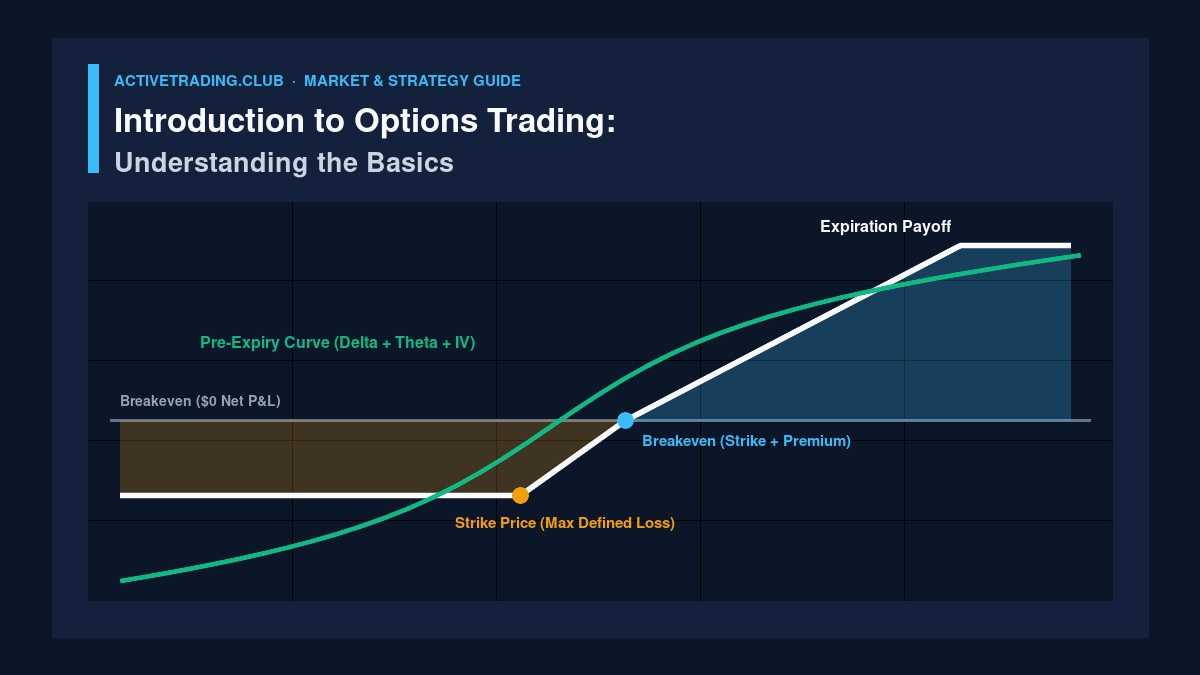
- You buy a Call Option with a Strike Price of $50 for a Premium of $2.00. The total cost for one contract (100 shares) is $200.
Scenario A (Price Rises): Next week, XYZ trades at $60.
- You can buy XYZ at $50.
- You purchase 100 shares at $50 ($5,000 total) and sell them at $60 ($6,000 total).
- Your profit is $1,000. After deducting your initial investment of $200, your net profit is $800.
- Result: You achieved a 400% return on your initial $200 investment, compared to a 20% increase in the stock price itself.
Scenario B (Price Stays or Falls): If XYZ remains at $50 or declines to $40, you would not exercise your option. Instead, you let it expire worthless.
- Result: You lose your initial investment of $200, illustrating the defined risk of options trading.
Put Options: The Right to Sell
A Put Option grants the buyer the right to sell the underlying asset at a specific price.
- When to use a Put: You would purchase a put option when you believe the underlying asset’s price will fall significantly before the option expires.
- The Logic: Buying a put means you expect the market price to drop below the strike price. If the price falls, you can buy the stock at the lower market price and sell it at the higher strike price.
Example of a Put: Suppose you own shares of Company ABC, currently trading at $100, but you are concerned about a potential negative earnings report.
- You buy a Put Option with a Strike Price of $100 for a Premium of $3.00 ($300 total for 100 shares).
Scenario A (Price Falls): The earnings report disappoints, and ABC drops to $80.
- You can sell ABC at $100.
- You buy 100 shares at $80 ($8,000 total) and sell them at $100 ($10,000 total).
- Your profit is $2,000. After subtracting your initial cost of $300, your net profit is $1,700.
Scenario B (Price Rises): If ABC increases to $110, you would not exercise your option. Instead, you let it expire.
- Result: You lose your $300 premium.
Key Terminology: The Vocabulary of Options
To trade options effectively, it’s essential to understand key terms. Here are four fundamental concepts in options terminology:
1. Strike Price
The Strike Price (or Exercise Price) is the predetermined price at which the underlying asset can be bought (for a call) or sold (for a put) if the option is exercised.
- It is the target price for your trade.
- A call option is considered “in the money” if the market price is above the strike price.
- A put option is “in the money” if the market price is below the strike price.
2. Expiration Date
The Expiration Date is the last day the option contract is valid.
- Options have a limited lifespan, and by this date, you must decide whether to exercise the option, sell it, or let it expire.
- Once the expiration date passes, the contract is void, and any unexercised rights are lost.
- Short-term options (expiring in days or weeks) are typically less expensive but lose value rapidly as expiration approaches. Long-term options (expiring in months) are more costly but allow more time for your prediction to manifest.
3. Premium
The Premium is the price you pay to purchase an option or the price you receive if you sell one.
- It is influenced by market conditions, the underlying stock’s price, time until expiration, and the stock’s volatility.
- The premium represents your maximum potential loss when buying an option. For example, if you buy a call for $2.00, your maximum loss is limited to that amount per share.
4. Intrinsic and Extrinsic Value
The premium of an option consists of two components: Intrinsic Value and Extrinsic Value (also known as Time Value).
Intrinsic Value
Intrinsic value represents the actual profit you would realize if you exercised the option immediately.
- For a Call: Intrinsic Value = (Current Market Price) - (Strike Price). If the market price is below the strike price, the intrinsic value is zero.
- For a Put: Intrinsic Value = (Strike Price) - (Current Market Price). If the market price exceeds the strike price, the intrinsic value is zero.
- Key Concept: Only options that are “in the money” have intrinsic value; “out of the money” options have zero intrinsic value.
Extrinsic Value (Time Value)
Extrinsic value refers to the additional amount paid for the potential of the option becoming profitable before expiration.
- It is primarily driven by time and volatility.
- As long as time remains, the option retains extrinsic value due to the possibility of favorable price movement.
- Time Decay: This is an important concept; extrinsic value diminishes as the expiration date nears. If the stock price remains stagnant, your option loses value daily simply due to reduced time for it to move favorably. This is why options are often viewed as “wasting assets.”
Example of Value Breakdown:
- Stock XYZ is at $55.
- You buy a Call with a Strike of $50.
- The option has a Premium of $7.00.
- Intrinsic Value: $55 (Market) - $50 (Strike) = $5.00 (immediate profit).
- Extrinsic Value: $7.00 (Total Premium) - $5.00 (Intrinsic) = $2.00 (cost of time remaining until expiration).
Actionable Takeaways for Beginners

Before proceeding to the next part of this series, ensure you grasp these key points:
- Define Your Bias: Determine whether you expect the stock to go up (Call) or down (Put). Your strategy hinges on this prediction.
- Understand Your Max Loss: When buying options, your risk is limited to the premium you paid. This contrasts with stock purchases, where you could lose the entire stock value if it declines to zero.
- Time is a Factor: Remember that options lose value due to time decay. You need the stock to move in your favor quickly to counteract this erosion.
- Don’t Chase “Cheap” Options: While options with low premiums seem appealing, they are often “out of the money” and less likely to succeed. Higher premiums may indicate options that are “in the money” and have a better chance of profitability.
- Paper Trade First: Utilize a simulator to practice buying calls and puts before risking real money. This approach allows you to learn without financial repercussions.
What’s Coming Next in This Series
In Part 2, we will explore Option Strategies. We will cover how to construct trades based on different market outlooks, including:
- Directional Strategies: Trading when you are bullish or bearish.
- Non-Directional Strategies: Trading when you expect the market to remain flat (e.g., Iron Condors).
- Hedging Strategies: Protecting your portfolio using puts.
We will also introduce the Greeks (Delta, Gamma, Theta, and Vega), which are critical metrics that traders use to assess risk and forecast how an option’s price will fluctuate.
Final Thoughts
Options trading is a valuable tool but requires a disciplined approach, a solid understanding of mechanics, and a clear strategy. By mastering the basics of calls, puts, strike prices, expiration dates, and the components of value (intrinsic vs. extrinsic), you have established a foundation for success.
The market is expansive, and opportunities abound, but mastery begins with knowledge. Take the time to review these concepts, and revisit this guide if you have questions. Once you feel confident in these fundamentals, you will be well-prepared to explore strategies in the next part of our series.
Welcome to the world of options trading. Let’s learn together.
Disclaimer: Trading options involves significant risk and is not suitable for every investor. The information provided in this guide is for educational purposes only and does not constitute financial advice, a recommendation, or an offer to sell or buy any security. Always consult with a qualified financial advisor before making investment decisions.
This is part 1 of 1 in our series on Mastering Options Trading: A Comprehensive Guide for Beginners. This article may contain affiliate links.