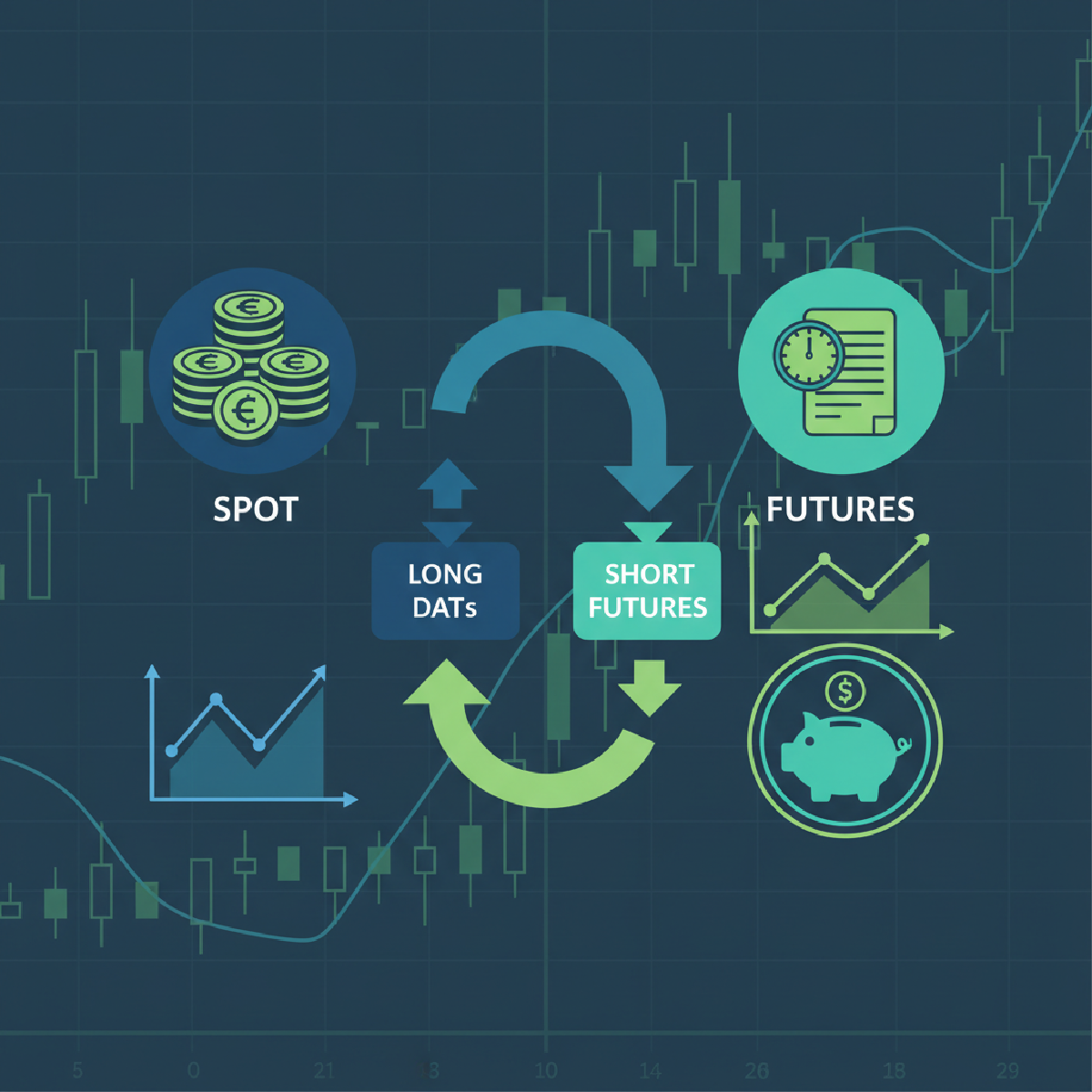
Understanding the Crypto Basis Trade: Spot vs. Futures
Part 1 of 3: Mastering the Crypto Basis Trade – How to Profit by Going Long DATs and Short Futures
On a recent day, Bitcoin was trading at $60,000 while futures contracts were priced at $61,000, creating a $1,000 basis. This scenario illustrates basis trading, a strategy that allows traders to profit from the differences between spot and futures prices without needing to predict market directions. Understanding this approach is essential for anyone looking to navigate the cryptocurrency markets effectively.
In this post, we’ll break down basis trading and how it can serve as a valuable tool in your trading strategy. By the end, you will have insights on structuring basis trades and the unique opportunities they present.
What Is the Basis in Crypto Trading?
Basis trading is essentially an arbitrage strategy that profits from the difference between the spot price and the futures price of an asset.
The Basis Formula
The basis is calculated using the formula:
Basis = Spot Price – Futures Price
The basis can be positive or negative, reflecting market conditions and the time until the futures contract expires. For example, if Bitcoin trades at $60,000 (spot) and $61,000 (futures), the basis is negative, indicating contango. On the other hand, if futures were priced at $59,000, the basis would be positive, indicating backwardation.
How Does a Basis Trade Work?
A basis trade involves taking opposing positions in the spot and futures markets. The typical setup includes:
- Long the spot asset (purchasing the actual cryptocurrency)
- Short the futures contract (selling a contract to deliver the asset in the future)
This creates a delta-neutral position, meaning your profit or loss depends on how the basis converges over time rather than on Bitcoin’s price movement itself.
As futures approach expiration, they are expected to converge with spot prices. If they don’t, arbitrageurs will capitalize on the difference, pushing prices back in line. It’s important to monitor how the basis changes as expiration nears, as failing to do so can impact potential profits.
Example: Basis Trade in Action
Let’s walk through a practical example using Bitcoin.
| Asset | Price | Position |
|---|---|---|
| Spot BTC | $60,000 | Long |
| Futures BTC | $61,000 | Short |
Basis: $60,000 – $61,000 = –$1,000
You buy 1 BTC at $60,000 and sell a futures contract at $61,000. If at expiration, BTC is trading at $65,000:
- Spot position: Sell your BTC for $65,000, resulting in a $5,000 profit.
- Futures position: Close your short at $65,000, leading to a $4,000 loss.
Net profit: $5,000 – $4,000 = $1,000 (the initial basis).
This example demonstrates that your profit is not dependent on price direction as long as the basis converges.
Why Is the Basis Trade Market-Neutral?
The strength of basis trading lies in its market-neutral nature. Your outcomes are not tied to market direction:
- If prices rise, your spot position gains while your futures short incurs a loss, and vice versa.
What matters is the difference between spot and futures prices—the basis. This characteristic makes it an appealing strategy for arbitrageurs, hedgers, and institutional traders looking for stable returns.
Introducing DATs: Digital Asset Tokens as Spot Exposure
In the evolving landscape of crypto trading, Digital Asset Tokens (DATs) have emerged as a viable option for gaining spot exposure.
What Are DATs?
DATs are tokenized versions of real crypto assets, backed 1:1 by the underlying asset and traded similarly to traditional spot crypto. For instance, a BTC DAT represents one Bitcoin held in reserve.
Why Use DATs for Basis Trading?
- Regulatory compliance: DATs are often issued by regulated entities, making them more attractive to institutional investors.
- Ease of trading: They can be traded on spot markets without the complexities of self-custody.
- Liquidity: Many DATs have high liquidity, facilitating effective basis trading.
- Transparency: The backing of DATs is usually audited and disclosed.
Using a BTC DAT provides similar economic exposure to holding actual Bitcoin while offering additional regulatory benefits.
The Role of Funding Rates in Perpetual Futures
Most crypto futures are perpetual contracts, which means they have no fixed expiration dates and utilize a funding rate mechanism to align futures prices with spot prices.
What Is the Funding Rate?
The funding rate consists of periodic payments exchanged between long and short positions. When futures prices are above spot prices (contango), longs pay shorts; when below (backwardation), shorts pay longs.
How Does the Funding Rate Affect Basis Trading?
- Positive funding rate: Futures are more expensive, allowing you to earn funding payments with a long spot and short futures position.
- Negative funding rate: Futures are cheaper, which can also be leveraged for profit.
This funding rate can enhance returns in basis trading, enabling you to benefit from both basis convergence and funding carry.
Spot vs. Futures: Key Differences
Understanding the differences between spot and futures markets is essential for effective basis trading.
| Feature | Spot Market | Futures Market |
|---|---|---|
| Asset Ownership | Yes (or via DATs) | No (contractual obligation) |
| Settlement | Immediate | Future date (or perpetual) |
| Leverage | Usually limited | Often high |
| Funding Rate | N/A | Yes (perpetuals) |
| Basis Trading Role | Long position | Short position |
Why Basis Trading Is Important in Crypto
Basis trading is significant for several reasons:
- Price Discovery: It helps maintain alignment between spot and futures prices, enhancing market efficiency.
- Risk Management: Hedgers use basis trades to lock in prices, reducing volatility risks.
- Profit Opportunities: Arbitrageurs can capture low-risk profits from pricing discrepancies, although they must navigate execution and counterparty risks.
- Market Stability: By exploiting basis discrepancies, traders help prevent extreme price divergences.
Final Thoughts
Basis trading is a fundamental strategy in the crypto derivatives markets, providing a blend of arbitrage and market-neutral profit potential. By understanding the relationship between spot and futures and utilizing tools like DATs and funding rates, you can develop a robust trading strategy.
As a next step, I suggest tracking the basis between your preferred crypto spot and futures pairs. Implement a simple monitoring system, whether through a spreadsheet or trading platform, to identify real-time opportunities as they arise.
Stay tuned for the next part of our series, where we’ll focus on executing basis trades with precision.
References:
- Phemex Academy: What Is Basis Trading?
- CME Group: Spot ETFs Give Rise to Crypto Basis Trading
- HighStrike: Basis Trading (2025)
- Cube Exchange: What is Basis?
- Robinhood: Spot Crypto vs ETFs vs Futures
- Backpack Learn: What is Basis Trading?
Series Navigation:
- Part 1: Understanding the Crypto Basis Trade: Spot vs. Futures
- Part 2: Executing the Basis Trade: How to Go Long DATs and Short Futures
- Part 3: Risk Management and Optimization in Basis Trading
This article may contain affiliate links. Always do your own research.