Understanding Funding Rates and Volatility in Crypto Trading
Funding rates are often overlooked in the world of perpetual futures trading, yet they play a significant role in determining profitability. Many traders concentrate solely on price movements, ignoring how funding rates can impact their returns. By understanding the interplay between funding rates and volatility, you can gain an advantage that allows you to optimize your trading strategy.
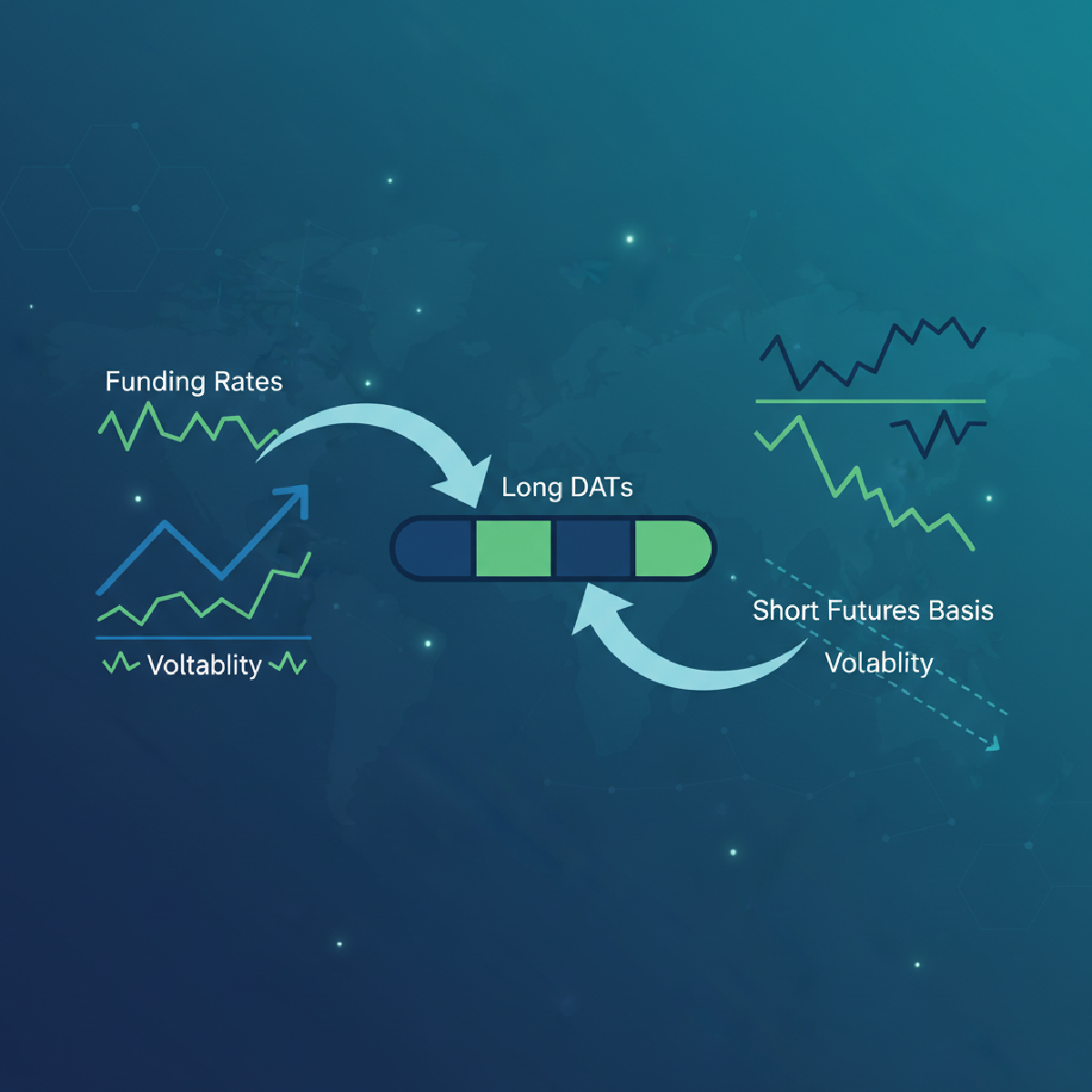
This article will explore how funding rates and volatility interact, particularly in the context of basis trades—specifically, long digital asset trades (DATs) paired with short futures positions. Grasping this relationship can enhance your risk-adjusted returns, whether you’re scalping for immediate profits or holding positions for the longer term.
What Are Funding Rates and Why They Matter
Perpetual futures contracts are a unique feature of cryptocurrency markets, trading indefinitely. To maintain alignment between perpetual contracts and the spot market, funding rates are employed.
Funding rates represent periodic payments exchanged between traders holding opposing positions in perpetual futures. Typically occurring every eight hours, these payments help keep perpetual prices in line with spot prices. When there’s a deviation, the funding rate adjusts to incentivize traders to take positions that restore balance in the market.
The Two Sides of Funding: Positive and Negative Rates
Understanding the nature of funding rates—whether positive or negative—is essential for any trading strategy.
Positive funding rates occur when the perpetual contract trades at a premium over the spot price. In these bullish conditions, long position holders pay a fee to short position holders. For example, if Bitcoin perpetuals trade at $70,500 while the spot price is $70,000, long traders are effectively compensating short traders for the premium.
Conversely, negative funding rates arise in bearish markets when perpetual contracts trade at a discount. Here, short position holders pay long position holders, creating an attractive scenario for long traders who essentially receive payment to hold their positions.
Calculating Your Funding Fees
Properly calculating funding fees is key to managing these costs effectively.
The formula is straightforward: Funding fee = Position value × Funding rate. For instance, if you hold a 5 BTC long position at a mark price of $70,000 with a funding rate of 0.01%, your funding fee would amount to $35. This fee directly impacts your profit and loss, regardless of price movements.
In a negative funding situation with the same position and a rate of -0.01%, you would receive $35 from short traders. Over time, these payments can accumulate and enhance your overall returns.
The Relationship Between Volatility and Funding Rates
A crucial yet often underappreciated aspect of crypto derivatives trading is how volatility influences funding rates. When volatility increases, the spread between the perpetual contract price and the mark price widens, leading to larger premiums or discounts and higher funding rates.
During significant price swings, traders often gravitate toward one side of the market, creating imbalances that inflate the funding rate. In extreme scenarios, such as flash crashes or major regulatory announcements, funding rates can spike, presenting lucrative opportunities for traders willing to adopt contrarian positions.
Premium Index and Interest Rate Components
The funding rate comprises two components: a stable interest rate and a dynamic premium index. While the interest rate remains constant, the premium index fluctuates based on market conditions. Monitoring the premium index can serve as a leading indicator for funding rate movements; an expanding premium often suggests higher future funding rates.
The Basis Trade Framework: Long DATs and Short Futures
Basis trading in crypto derivatives allows traders to take advantage of funding rate differentials. To execute a basis trade:
- Buy the underlying asset on the spot market.
- Simultaneously short the perpetual futures contract.
- Collect funding rate payments as the short position pays you.
- Close both positions once the basis converges or funding becomes unfavorable.
This market-neutral strategy does not rely on price direction but instead on the persistence of favorable funding rates to offset transaction costs and generate profits.
Calculating the Basis and Profit Potential
The basis is the difference between the perpetual futures price and the spot price. For example, if the spot price of Bitcoin is $70,000 and the perpetual price is $70,200, you have a positive basis of $200. Over multiple funding periods, these payments can lead to substantial profits.
However, it’s important to account for transaction costs such as exchange fees and potential slippage. Even if profits appear modest, minimizing risk allows for repeatable trades as long as funding rates remain favorable.
Timing Your Entry and Exit
Timing your entry and exit in a basis trade is crucial. Enter when the basis is wide enough to cover transaction costs, funding rates are elevated, and volatility is high but stable. Maintain a checklist to ensure informed decision-making.
For exits, aim for your profit target or exit if funding rates turn negative or if the basis converges below breakeven.
Volatility as a Predictive Tool
Volatility not only affects funding rates but also reflects trader sentiment, which can predict future funding rate movements. A surge in volatility often indicates strong market conviction, suggesting that elevated funding rates may continue.
Conversely, a contraction in volatility following a spike can signal a decline in funding rates. This creates an opportunity for basis trades: enter during volatility expansion and exit as it contracts.
Advanced Strategies: Exploiting Funding Rate Volatility
One strategy is to directly trade the funding rate itself. When rates spike significantly, they tend to revert to historical averages. You could short the perpetual when rates exceed a certain threshold, anticipating normalization.
Another approach involves fading volatility spikes, particularly when they occur under questionable market conditions. If Bitcoin experiences an unexpected move based on unreliable news, the resulting premium can be exploited before it normalizes.
Practical Implementation: Step-by-Step Guide
- Select Your Exchange and Asset: Choose a reputable exchange like Binance or Bybit with competitive fees.
- Calculate Your Position Size: Limit risk to no more than 2% of your account on a single trade.
- Monitor the Basis: Keep a close watch on the perpetual-to-spot spread in real-time.
- Verify Funding Rate Sustainability: Check current and historical funding rates to assess trends.
- Calculate Profit Potential: Ensure potential profits exceed your minimum acceptable threshold.
- Execute Entry: Buy the spot asset and short the perpetual simultaneously to minimize slippage.
- Monitor and Manage: Set alerts for changes in funding rates and volatility spikes.
- Exit Strategy: Exit when profit targets are reached, funding rates turn negative, or the basis converges.
Real-World Market Conditions and Adaptations
In a bull market, funding rates typically remain positive, making basis trades easier to implement. However, be cautious of funding rate compression as the market matures. In bear markets, negative funding rates can make traditional basis trades unprofitable; however, inverse basis trades may still yield returns.
During extreme volatility, such as flash crashes, significant opportunities can arise, but these require swift execution and composure to capitalize effectively.
Key Takeaways for Active Traders
Understanding funding rates is essential for successful trading in perpetual futures. Recognizing how they interact with volatility provides a critical edge. Basis trades offer a systematic strategy for generating consistent returns while minimizing directional risk.
Discipline in execution and risk management is crucial. Treat basis trades as routine processes rather than isolated opportunities. By mastering the relationship between funding rates and volatility, you can position yourself to outperform less informed traders.
Watch for expanding volatility and shifting funding rates; these dynamics are your key indicators. Staying attuned to these factors will help you maintain profitability in the evolving crypto landscape.
This article may contain affiliate links. Always do your own research.