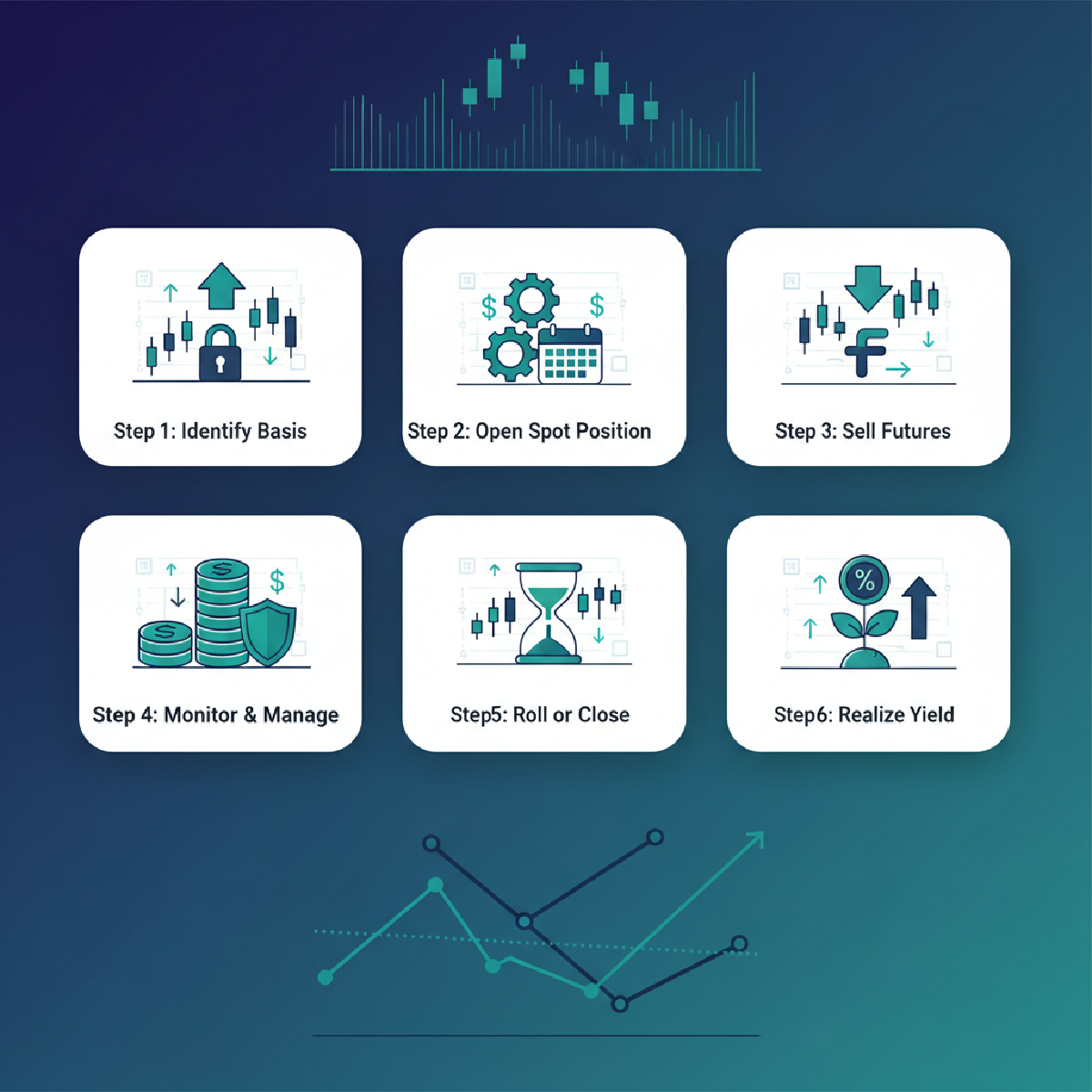
In the past month, Bitcoin futures have consistently traded at a premium, with the basis fluctuating between $2,000 and $3,000. This trend is common in the cryptocurrency markets, where the difference between spot and futures prices can create trading opportunities. This guide outlines how to effectively execute basis trades, a strategy that not only mitigates volatility but also enhances yield in your crypto portfolio.
Understanding Basis Trading in Crypto
The basis is the difference between the futures price and the spot price of an asset:
[ \text{Basis} = \text{Futures Price} - \text{Spot Price} ]
In cryptocurrency, futures can either trade at a premium (contango) or a discount (backwardation) to the spot price. Traders can leverage this spread by taking positions in both markets, profiting from the expected convergence of prices at contract expiration or creating a market-neutral yield.
Step 1: Identify and Measure the Basis
Begin by selecting your crypto asset and futures contract. Bitcoin (BTC) and Ether (ETH) are strong candidates due to their liquidity.
- Choose your asset: Bitcoin is a prime choice.
- Select the futures contract: Consider using CME Bitcoin futures, as they are well-regulated.
- Gather prices: Obtain spot prices from reputable exchanges while sourcing futures prices from the contract exchange.
- Calculate the basis:
[ \text{Basis} = \text{Futures Price} - \text{Spot Price} ]
For example, if BTC trades at $80,000 on the spot market and $82,000 in futures, your basis is $2,000. A narrowing basis indicates that futures and spot prices are converging, which is essential for profitable basis trading.
Step 2: Decide on Your Trade Direction
Your trade setup will depend on whether the basis is positive or negative:
- Positive Basis (Futures > Spot): Buy spot and sell futures. This allows you to lock in the premium as futures prices decline.
- Negative Basis (Spot > Futures): Sell spot and buy futures. This captures gains when either the spot price decreases or the futures price increases.
The positive basis setup—buying spot and shorting futures—is the more common approach.
Step 3: Execute the Basis Trade
3.1 Buy Spot Crypto
Purchase your crypto asset on a liquid exchange, ensuring it is securely held.
3.2 Sell (Short) Futures Contract
Short an equivalent amount of futures contracts. It’s advisable to use regulated exchanges like CME or Binance for reliability.
Example: Buy 1 BTC at $80,000 and short 1 BTC CME futures at $82,000. This locks in a $2,000 basis premium, anticipating convergence at expiration.
Step 4: Use BTIC for Fixed Spread Trading
BTIC or Basis Trade at Index Close contracts settle at the index close price, allowing you to fix the basis spread upfront. This approach minimizes uncertainty from daily price fluctuations and is particularly beneficial for institutional traders. If available, consider BTIC for more predictable yield.
Step 5: Risk Management and Monitoring
Monitor Basis Changes
Stay informed about fluctuations in the basis due to market sentiment and economic factors. It’s crucial to track these changes to determine optimal entry or exit points.
Contract Maturity
As contracts approach expiration, the basis should narrow. Be prepared to roll futures positions if necessary, while being aware of the associated costs.
Funding Rates and Leverage
Funding rates can serve as a dynamic basis in perpetual futures. Ensure these costs are incorporated into your trading strategy, and manage your margin to avoid liquidation risks.
Hedging Volatility
Although basis trades are typically market-neutral, they carry risks. Sudden price divergences or liquidity issues can affect your positions. It’s wise to use stop-loss orders judiciously and hedge any additional exposure as needed.
Step 6: Optimize Yield by Capitalizing on Basis Fluctuations
To maximize yield, look for steep basis premiums and be ready to exit or roll your trades as the basis compresses. Utilize analytical tools to monitor market metrics, and consider integrating basis trades with lending or staking to enhance your overall yield.
Practical Tips and Tools
- Use real-time market data dashboards for continuous tracking.
- Look for platforms that seamlessly integrate spot and futures trading for efficient execution.
- Consider employing automated trading bots configured for basis trading parameters to ease the burden of manual monitoring.
- Keep detailed records of all trades for performance tracking and tax purposes.
Final Thoughts
Before entering any trade, calculate and understand the current basis. Ensure your spot and futures positions are equal for effective hedging. If interested in locking in fixed spreads, seek out BTIC contracts. Maintain vigilance over basis movements and funding rates, and manage your risk carefully.
For traders looking to enhance yield, now is an opportune moment to act. Monitor for steep basis opportunities and consider combining your trades with other yield-enhancing strategies.
For foundational concepts, revisit Part 1: Introduction to Crypto Futures and Basis Trading Fundamentals.
This is part 2 of 2 in our series on Mastering Basis Trading with Crypto Futures: Hedge Volatility and Boost Yield. This article may contain affiliate links.
Related Reading
- Executing the Basis Trade: Step-by-Step Setup and Risk Management
- Understanding the Crypto Basis Trade: Spot vs. Futures
- Mastering the Crypto Basis Trade
- Comparing Bitcoin Futures on Kraken vs Other Exchanges
This article may contain affiliate links. Always do your own research.