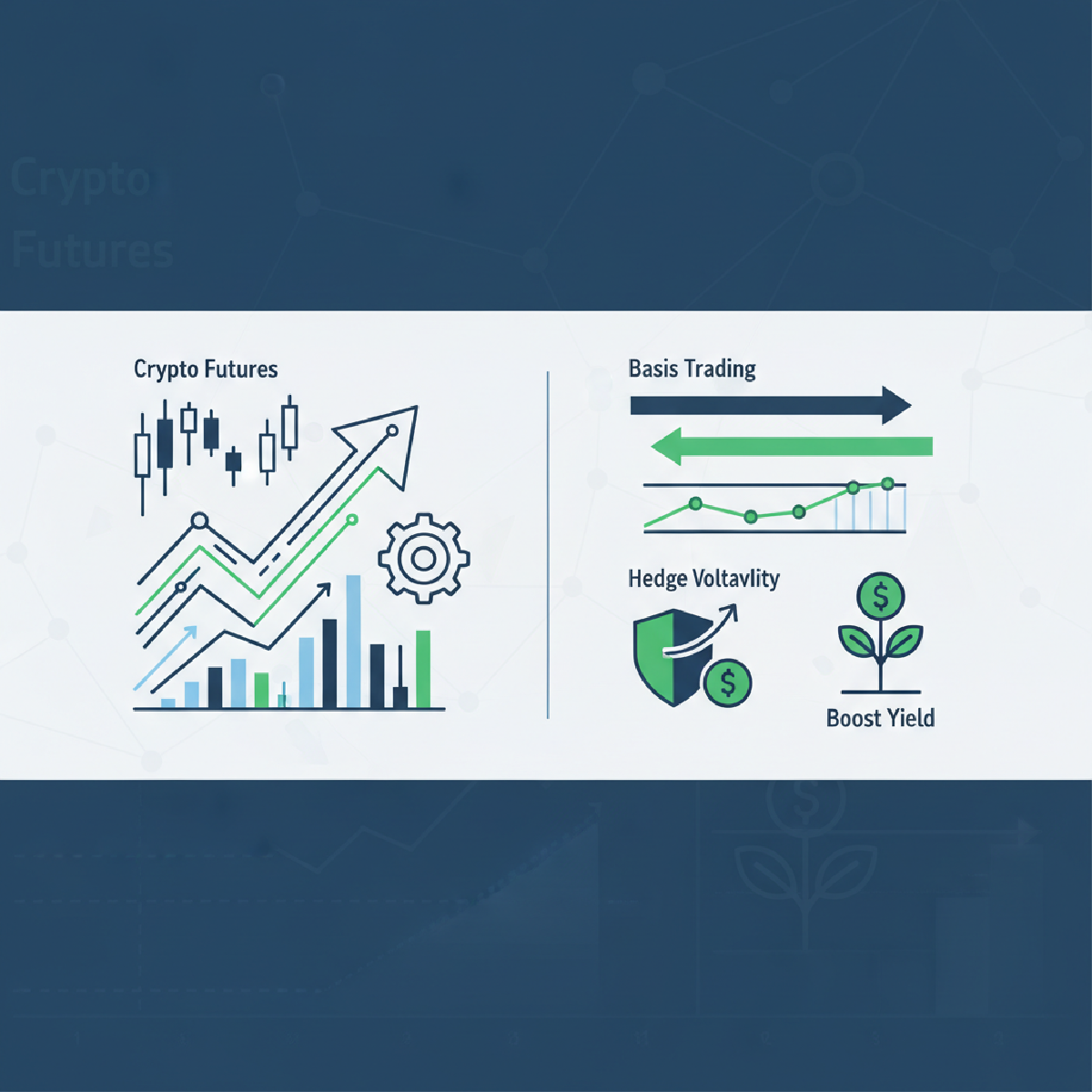
Introduction to [Crypto](https://www.kraken.com/learn/trading/[futures](https://www.coinbase.com/learn/futures/fundamentals-understanding-the-basics) Futures and Basis Trading Fundamentals
Part 1 of 2: Mastering Basis Trading with Crypto Futures – Hedge Volatility and Boost Yield
In recent months, interest in crypto futures trading has increased, particularly as Bitcoin has stabilized around the $30,000 mark. For traders looking to navigate this environment, understanding how to use futures for risk management is essential. This article will introduce you to an important trading technique that focuses on basis trading with crypto futures.
By the end of this article, you’ll understand:
- [What](https://primexbt.com/for-traders/[what](https://robinhood.com/us/en/learn/articles/what-are-crypto-futures/) crypto futures are and how they work
- The concept of basis and why it matters
- How basis reflects market sentiment and volatility
- Techniques for using futures to hedge and enhance yield
This is your first step toward mastering basis trading—a strategy that can help mitigate risks, capture yield, and provide a more confident approach to the crypto markets.
What Are Crypto Futures?
Crypto futures are contracts that enable traders to speculate on or hedge against future cryptocurrency prices without needing to own the actual asset. A futures contract is an agreement to buy or sell a specific amount of a cryptocurrency at a predetermined price on a set future date.
When trading a crypto futures contract, you are not directly buying Bitcoin or Ethereum. Instead, you are entering a contract that derives its value from the price movements of the crypto asset.
You can take one of two main positions:
- Long (Buy): You agree to buy the asset at a fixed price in the future, profiting if the price rises.
- Short (Sell): You agree to sell the asset at a fixed price in the future, profiting if the price falls.
For example, if Bitcoin is trading at $60,000 and you expect it to increase, you could go long on a futures contract. Conversely, if you think the price will decline, you might choose to go short.
Key Features of Crypto Futures
- No Asset Ownership: You don’t have to hold the underlying crypto, simplifying the trading process.
- Leverage: Futures are traded on margin, allowing control of larger positions with less capital, which can amplify both gains and losses.
- Expiration: Each futures contract has a specific expiration date, at which point it is settled—either in cash or through asset delivery, as dictated by the exchange.
- Zero-Sum Game: Gains for one trader equate to losses for another, emphasizing the need for a solid strategy.
Why Trade Crypto Futures?
Crypto futures provide several advantages:
- Speculation: You can profit from price movements in either direction.
- Hedging: They offer a way to protect your existing crypto holdings against price declines.
- Leverage: You can control larger positions with a relatively small capital investment.
- Liquidity: Major futures markets for Bitcoin and Ethereum are highly liquid, facilitating easy entry and exit from positions.
However, these benefits come with significant risks, particularly due to leverage and market volatility. Understanding the fundamentals is crucial before exploring advanced strategies like basis trading.
Understanding the Basis: Spot vs. Futures Price
A key concept in this discussion is the basis.
What Is Basis?
Basis is the difference between the spot price (the current market price of the asset) and the futures price (the price at which the asset is traded in the futures market).
Basis = Futures Price – Spot Price
- A positive basis (futures price higher than spot) is known as contango.
- A negative basis (futures price lower than spot) is termed backwardation.
Why Does Basis Matter?
Basis serves as a critical indicator of market sentiment, financing costs, and expectations regarding future price movements.
Example: Bitcoin Basis
For example:
- Bitcoin spot price: $60,000
- Bitcoin futures price (3-month contract): $63,000
In this case, the basis is $3,000 (positive), indicating that the market anticipates an increase in Bitcoin’s value over the next three months or that there are costs associated with holding the asset.
Why Do Futures Typically Trade at a Premium?
In many markets, including crypto, futures often trade at a premium to the spot price, indicating contango.
Reasons for a Positive Basis
- Implied Financing Rate: Holding the asset incurs costs—such as opportunity costs, storage, and insurance. Futures buyers often pay a premium to avoid these expenses.
- Time to Maturity: The longer until expiration, the higher the basis tends to be due to increased uncertainty and financing costs.
- Market Sentiment: Bullish sentiment among traders can drive futures prices higher.
- Volatility: Increased volatility raises the risk premium, further widening the basis.
Implications of a Positive Basis
- Yield Opportunity: If you hold the physical asset and sell futures, you can capitalize on the basis as a source of yield.
- Hedging: A positive basis allows you to hedge your holdings at a premium, reducing downside risk.
How Basis Reflects Market Factors
Basis is dynamic and influenced by several market factors:
1. Implied Financing Rate
The difference between spot and futures prices reflects the implied cost of carry—the cost of holding the asset until the futures contract expires. In the crypto space, this is often expressed as an annualized yield.
For instance, if the basis is $3,000 on a $60,000 spot price over three months, the implied financing rate can be calculated as:
- ($3,000 / $60,000) × (12 / 3) = 20% annualized
This implies a potential 20% annual yield by holding the asset and selling futures, assuming the basis remains unchanged.
2. Time to Maturity
As expiration approaches, the basis typically converges to zero since the futures price must align with the spot price at expiry.
3. Volatility
Increased volatility can widen the basis as traders demand more compensation for taking on risks in uncertain environments.
Hedging Volatility with Futures Contracts
One of the most effective applications of crypto futures is hedging volatility.
What Is Hedging?
Hedging involves reducing risk by taking offsetting positions. In the crypto market, this often means protecting your spot holdings from price declines.
How to Hedge with Futures
If you own 1 Bitcoin and are concerned about a potential price drop, you could:
- Sell (short) a Bitcoin futures contract at the current futures price.
- If the price declines, your spot holding depreciates, but your futures position gains value, offsetting any loss.
This creates a basis hedge—you lock in the difference between spot and futures, minimizing your exposure to price fluctuations.
Example: Hedging with Basis
- Spot price: $60,000
- Futures price: $63,000
- Basis: $3,000
You sell 1 Bitcoin futures contract at $63,000.
If Bitcoin falls to $50,000:
- Spot loss: $10,000
- Futures gain: $13,000
- Net gain: $3,000 (the basis)
If Bitcoin rises to $70,000:
- Spot gain: $10,000
- Futures loss: $7,000
- Net gain: $3,000 (the basis)
In both scenarios, you’ve secured the basis as a yield, reducing your exposure to price volatility.
Practical Applications of Basis Trading
Basis trading is useful not only for hedging but also for boosting yield and managing risk.
1. Yield Enhancement
By holding the asset and selling futures, you can capture the basis, which can be particularly appealing in markets with a significant positive basis.
2. Volatility Management
Basis trading helps mitigate your exposure to price swings, contributing to a more stable portfolio.
3. Market Neutral Strategies
You can create market-neutral positions, profiting from the basis itself rather than relying on market direction.
What’s Next in This Series?
In Part 2, we will explore advanced basis trading strategies, including:
- Identifying and capitalizing on basis opportunities
- Executing basis trades effectively
- Risk management techniques tailored for basis trading
- Real-world examples and case studies
We will also discuss how to utilize basis trading to hedge volatility and enhance yield across varying market conditions.
Final Thoughts
Understanding crypto futures and basis trading is crucial for managing risk and enhancing yield in volatile markets. By mastering the fundamentals of futures and the dynamics of basis, you can navigate the crypto landscape with more confidence.
As you await Part 2, start monitoring the basis in your preferred crypto markets. Think about how you might leverage it to hedge against volatility and improve your returns. Pay attention to significant shifts in the basis for potential trading opportunities.
Next in Series:
👉 Part 2: Advanced Basis Trading Strategies – Hedge Volatility and Boost Yield
Have questions or want to share your experiences with futures and basis trading? Leave a comment below or join our community discussion!
This is part 1 of 2 in our series on Mastering Basis Trading with Crypto Futures: Hedge Volatility and Boost Yield. This article may contain affiliate links.
Related Reading
- Understanding the Crypto Basis Trade: Spot vs. Futures
- Understanding Funding Rates and Volatility
- How to Use Basis Trading with Crypto Futures
- Mastering the Crypto Basis Trade
This article may contain affiliate links. Always do your own research.