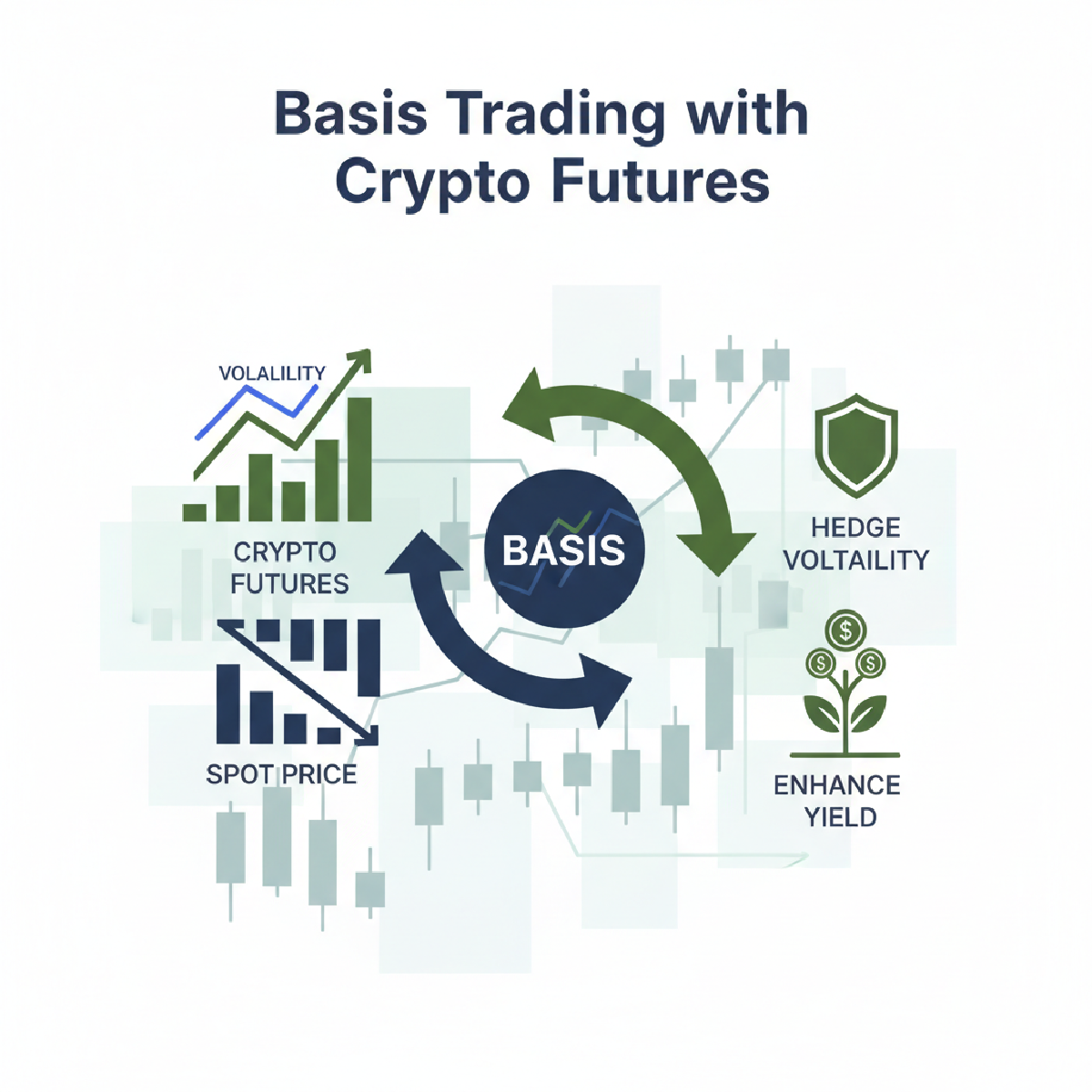
How to Use [Basis](https://www.britannica.com/money/[basis](https://highstrike.com/basis-trading/) Trading with Crypto [Futures](https://www.cmegroup.com/education/courses/trading-at-a-basis-to-an-index-btic-taco/[understanding](https://www.cmegroup.com/education/courses/trading-at-a-basis-to-an-index-btic-taco/[understanding](https://www.cmegroup.com/education/courses/trading-at-a-basis-to-an-index-btic-taco/understanding-basis-trade-at-index-close-btic.html) to Hedge Volatility and Enhance Yield
The price of Bitcoin has recently fluctuated significantly, surging from $20,000 to over $60,000 before retreating again. This volatility characterizes the cryptocurrency market, prompting traders to seek effective risk management strategies. Basis trading presents a practical approach by leveraging the price differences between spot and futures markets to create profit opportunities.
What Is Basis Trading?
Basis refers to the difference between the spot price (the current market price) and the futures price (the agreed price for future transactions). The formula is straightforward:
Basis = Spot Price – Futures Price
This difference can be either positive or negative. In the crypto sector, a negative basis is often seen, where futures prices exceed spot prices—this scenario is known as contango. Conversely, in bearish trends, futures may trade at a discount, referred to as backwardation.
The basis is influenced by various factors, including future supply and demand, financing costs, and market sentiment. For instance, during a bullish phase while trading Ethereum, I observed that financing costs and yield opportunities significantly impacted the basis.
How Basis Trading Works
Basis trading operates as an arbitrage strategy, allowing traders to take simultaneous positions in both the spot and futures markets to profit from changes in the basis. The common method is the cash-and-carry trade:
- Buy the asset in the spot market.
- Sell the same amount in the futures market.
- Hold until the futures contract expires or the basis converges.
- Close both positions to secure the profit.
This strategy is market-neutral, meaning it doesn’t rely on the asset’s price direction but rather on the narrowing of the basis over time.
Example: Bitcoin Basis Trade
Imagine the spot price of BTC is $80,000 while the futures price for a three-month contract is $82,000, resulting in a basis of -$2,000. If I anticipate that the basis will decrease as the expiration date approaches, I might execute a cash-and-carry trade:
- Buy 1 BTC at $80,000 in the spot market.
- Sell 1 BTC futures contract at $82,000.
- Hold until expiration.
At expiration, if the spot price rises to $81,000, I can sell my BTC for that amount, buy back the futures contract at the same price, and realize a profit of $1,000 per BTC, minus any fees.
How to Use Basis Trading to Hedge Volatility
Given the inherent volatility of cryptocurrencies, hedging becomes essential. Basis trading allows traders to lock in a known return despite price fluctuations.
When executing a cash-and-carry trade, you effectively lock in the basis, meaning your profit hinges on the difference between the spot and futures prices rather than the asset’s price movement. For example, if I hold BTC and anticipate a price drop, I can:
- Sell BTC futures to hedge my spot position.
- If the price declines, losses in my spot position can be offset by gains in the futures market.
- Conversely, if the price rises, gains in my spot position may be counterbalanced by losses in the futures market.
This strategy establishes a hedged position, reducing exposure to volatility.
How to Enhance Yield with Basis Trading
Basis trading can also yield returns through the positive carry of holding spot and shorting futures, particularly during periods of contango.
Step-by-Step: Enhancing Yield
- Monitor the basis: Use platforms like Cube Exchange or Binance Academy to track the basis of your selected assets.
- Identify opportunities: Look for assets with a significant negative basis.
- Execute the trade: Buy in the spot market and sell futures.
- Hold until convergence: Expect the basis to narrow as the futures contract nears expiration.
- Close the trade: Realize your profit.
Example: Ethereum Basis Trade
Suppose the spot price of ETH is $3,000 and the futures price for a three-month contract is $3,100, resulting in a basis of -$100. I would buy 10 ETH at $3,000 and sell 10 ETH futures at $3,100. If, at expiration, the futures price converges to $3,050, I can sell my ETH for $3,050 and buy back the futures at that price, locking in a profit of $50 per ETH, minus fees.
Risks and Considerations
While basis trading can be advantageous, it carries certain risks:
- Basis Risk: The basis may not converge as anticipated, especially in illiquid markets or during extreme volatility.
- Liquidity Risk: In less liquid markets, exiting positions at favorable prices can be difficult.
- Counterparty Risk: Use reputable exchanges and counterparties to mitigate default risks.
- Financing Costs: Be aware that borrowing costs can reduce your profits.
- Regulatory Risk: Stay updated on local crypto regulations, as they can affect your strategy.
Conclusion
Basis trading is a valuable strategy for cryptocurrency traders looking to hedge against volatility and enhance yield. By taking simultaneous positions in the spot and futures markets, you can secure returns while managing risks from price fluctuations.
Start by monitoring the basis for your preferred assets and consider executing your first cash-and-carry trade. As you gain experience, you may explore more advanced strategies like rolling futures and ETF-based trading.
While the crypto market remains unpredictable, effective basis trading can help you navigate its complexities and unlock new opportunities for yield and risk management. Pay close attention to the basis, and be prepared to act when conditions align favorably. Happy trading!
This article may contain affiliate links. Always do your own research.