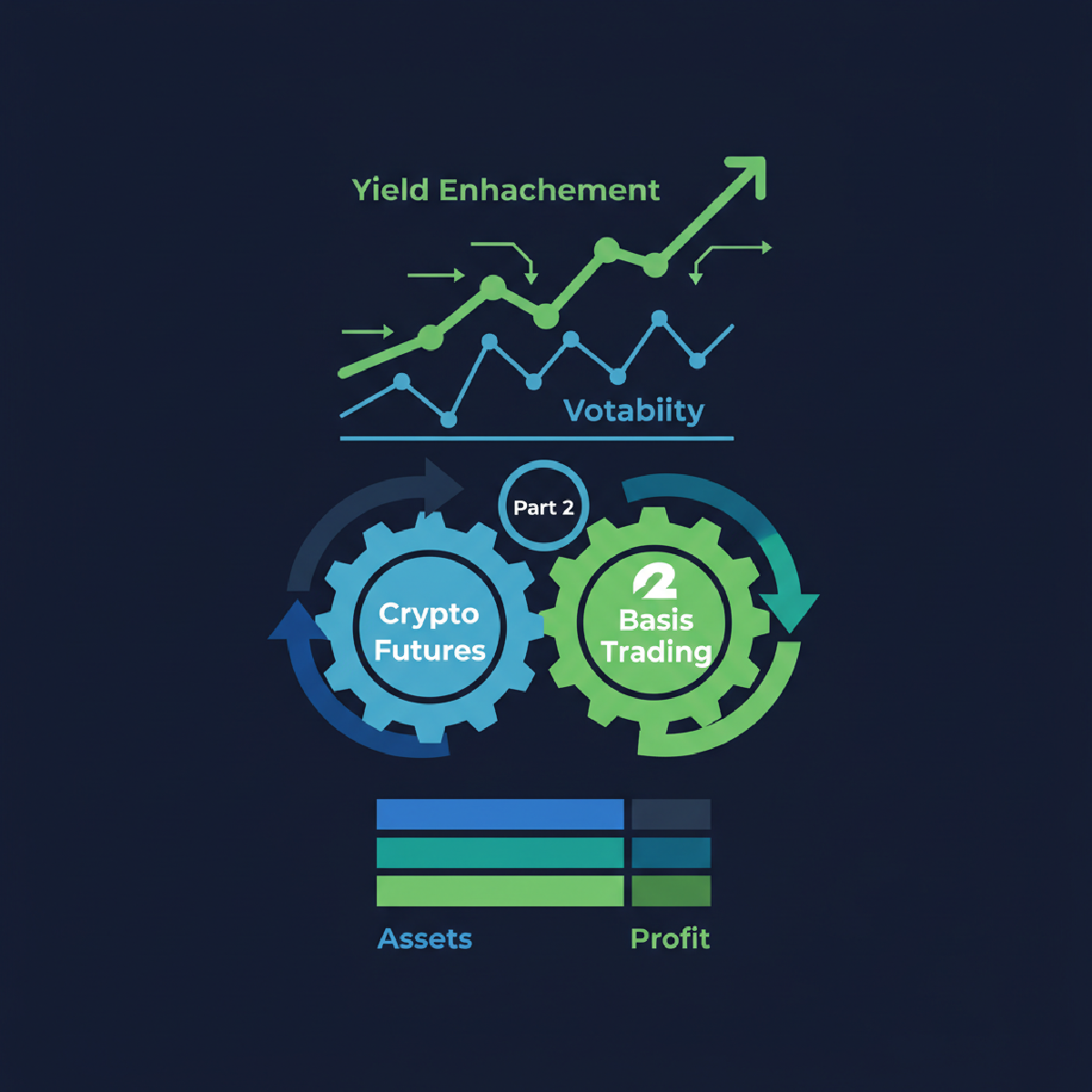
How to Use Basis Trading with Crypto Futures to Hedge Volatility and Enhance Yield — Part 2
In recent months, Bitcoin futures have consistently traded at a premium over spot prices, often exceeding $80,000 on futures while spot prices hover around $78,000. This contango environment provides an opportunity for traders engaged in basis trading, a strategy designed to hedge against volatility and enhance yield in the crypto markets.
Understanding how institutional traders structure these trades can lead to consistent returns, regardless of market direction.
Understanding Market Structures: Contango and Backwardation
Before entering any trades, it’s crucial to understand the market structure at play. Basis trading relies on two primary conditions: contango and backwardation, each offering different profit potentials.
Contango occurs when futures prices exceed spot prices. For example, if Bitcoin is trading at $80,000 on spot exchanges and $82,000 on futures, this positive basis indicates a typical contango scenario. In the crypto space, this is common due to carry costs such as financing, storage, and opportunity costs. Traders can capitalize on this structure through cash-and-carry arbitrage, leveraging the premium offered by futures.
In contrast, backwardation happens when futures prices drop below spot prices. This typically indicates bearish sentiment and can present opportunities, but these situations are often less reliable and short-lived in the volatile crypto markets.
Recognizing whether the market is in contango or backwardation significantly influences your trading strategy. Most opportunities are found in contango, where the structural premium helps offset operational costs.
Cash-and-Carry Arbitrage: Your Go-To Basis Trading Strategy
The cash-and-carry trade serves as the foundation of basis trading, allowing traders to secure market-neutral returns. While it may appear complex, the underlying mechanics are quite straightforward.
Let’s illustrate with a practical Bitcoin example:
- Spot Bitcoin price: $80,000
- Futures price: $82,000
- Basis: +$2,000
- Financing rate: 8% annualized
- Exchange fees: 0.1%
Imagine a trader named Alice who executes the following:
- Buy spot Bitcoin: She purchases 1 BTC at $80,000.
- Sell futures: Simultaneously, she sells a futures contract for 1 BTC at $82,000.
- Finance the position: Alice borrows USD at an 8% annualized rate to fund her spot purchase.
At expiration, her profit and loss would break down as follows:
- Futures P&L: If spot Bitcoin rises to $85,000 at expiration, Alice delivers her Bitcoin against the futures contract, locking in the $82,000 price.
- Financing cost: Borrowing $80,000 for 90 days at 8% costs about $1,600.
- Exchange fees: Approximately $80 for the spot purchase.
- Net profit: $2,000 basis - $1,600 financing - $80 fees = $320 profit on $80,000 deployed.
This results in a 1.6% return over 90 days, or an annualized 6.4%, with no directional risk. Regardless of whether Bitcoin rises to $100,000 or falls to $60,000, Alice’s profit remains fixed due to her locked-in prices.
The reason this strategy works is that futures and spot prices converge at contract expiration. As expiration approaches, the basis tightens, creating a clear profit opportunity.
Hedging with Basis Trading: A Smart Risk Management Strategy
While many traders focus on chasing yield, the hedging aspect of basis trading is equally valuable. This approach allows you to maintain exposure to an asset while mitigating risks associated with price volatility.
Consider a fund manager holding 100 Bitcoin. She is confident in Bitcoin’s long-term potential but is concerned about short-term price fluctuations. Selling her position to avoid losses contradicts her conviction and could result in missed gains.
Instead, she can:
- Maintain her 100 BTC position, preserving her long-term view.
- Sell 100 BTC futures at a premium.
- Capture the basis as profit while retaining her exposure.
If Bitcoin rallies, her spot position gains offset her futures losses, allowing her to benefit from the basis premium. Conversely, if Bitcoin drops, her gains and losses balance out, enabling her to profit from the basis without any directional exposure. This strategy effectively transforms a volatile asset into a yield-generating tool.
Advanced Insights: Basis Momentum and Market Sentiment
Understanding how basis levels evolve can significantly enhance your trading strategy. Recent trends indicate that Bitcoin’s basis is closely tied to market sentiment and price momentum.
During bullish market phases, such as after ETF approvals, basis premiums can surge to 15–30% annualized. Conversely, during bearish phases, like the downturn in November 2022, futures might slip into backwardation. Recognizing this relationship is crucial; expanding basis levels often signal aggressive bullish positioning, marking prime opportunities for basis trades.
When basis contracts narrow or turn negative, it’s advisable to reconsider your position sizes or wait for more favorable conditions.
Implementing Your Basis Trade: A Step-by-Step Approach
Here’s how to translate these concepts into actionable steps:
Identify Market Conditions: Calculate the basis for Bitcoin and Ethereum. If the basis is positive and exceeds your expected financing costs, it represents a viable opportunity.
Calculate All-In Costs: Assess your complete cost structure, considering financing rates, exchange fees, and any additional expenses. Ensure your anticipated profit exceeds these costs for the trade to be worthwhile.
Execute in Sequence: Timing is crucial. Arrange your financing first, purchase spot, and then sell futures. Minimizing the time gap between these steps reduces directional exposure.
Monitor and Manage: Keep an eye on basis levels and financing costs as expiration approaches. If the basis widens unexpectedly, reevaluate your position.
Example: A Basis Trade in Ethereum
To solidify these concepts, let’s consider an Ethereum example:
- Spot Ethereum: $3,000
- 3-month futures: $3,120
- Basis: +$120
- Financing rate: 6% annualized
- Exchange fees: 0.08%
You decide to deploy $300,000, buying 100 ETH at $3,000 each.
Execution Steps:
- Borrow $300,000 at 6% (costing $4,500 over 90 days).
- Buy 100 ETH on the spot market.
- Sell 100 ETH futures at $3,120.
- Total fees: $240 + $37 in custody costs.
Regardless of Ethereum’s price at expiration, you deliver your 100 ETH against the futures, securing the $120 basis. Your net profit would be significant—achieved with no directional risk.
Common Risks and Mitigation Strategies
Despite a solid understanding, basis trading carries risks:
Execution Risk: The timing between buying spot and selling futures may expose you to price movement. To mitigate this, aim to execute trades simultaneously.
Financing Rate Spikes: Unexpected increases in lending rates can impact your carry costs. Lock in rates before execution when possible.
Liquidity Risk: Large trades on thin exchanges can lead to slippage. Stick to major exchanges and consider breaking up large trades.
Counterparty Risk: Holding spot on centralized exchanges while shorting futures introduces risk if the exchange fails. Use reputable custodians or diversify holdings across multiple platforms.
Final Thoughts
Basis trading offers a robust method for generating yield and hedging against volatility in crypto markets. By mastering the mechanics and understanding market structures, you can develop a reliable trading strategy.
In Part 3, we’ll explore advanced techniques such as multi-leg trades and how to scale basis trading into a systematic portfolio approach. For now, focus on calculating the current basis and monitoring market conditions. These foundational skills will position you for success in the evolving crypto landscape.
This article may contain affiliate links. Always do your own research.