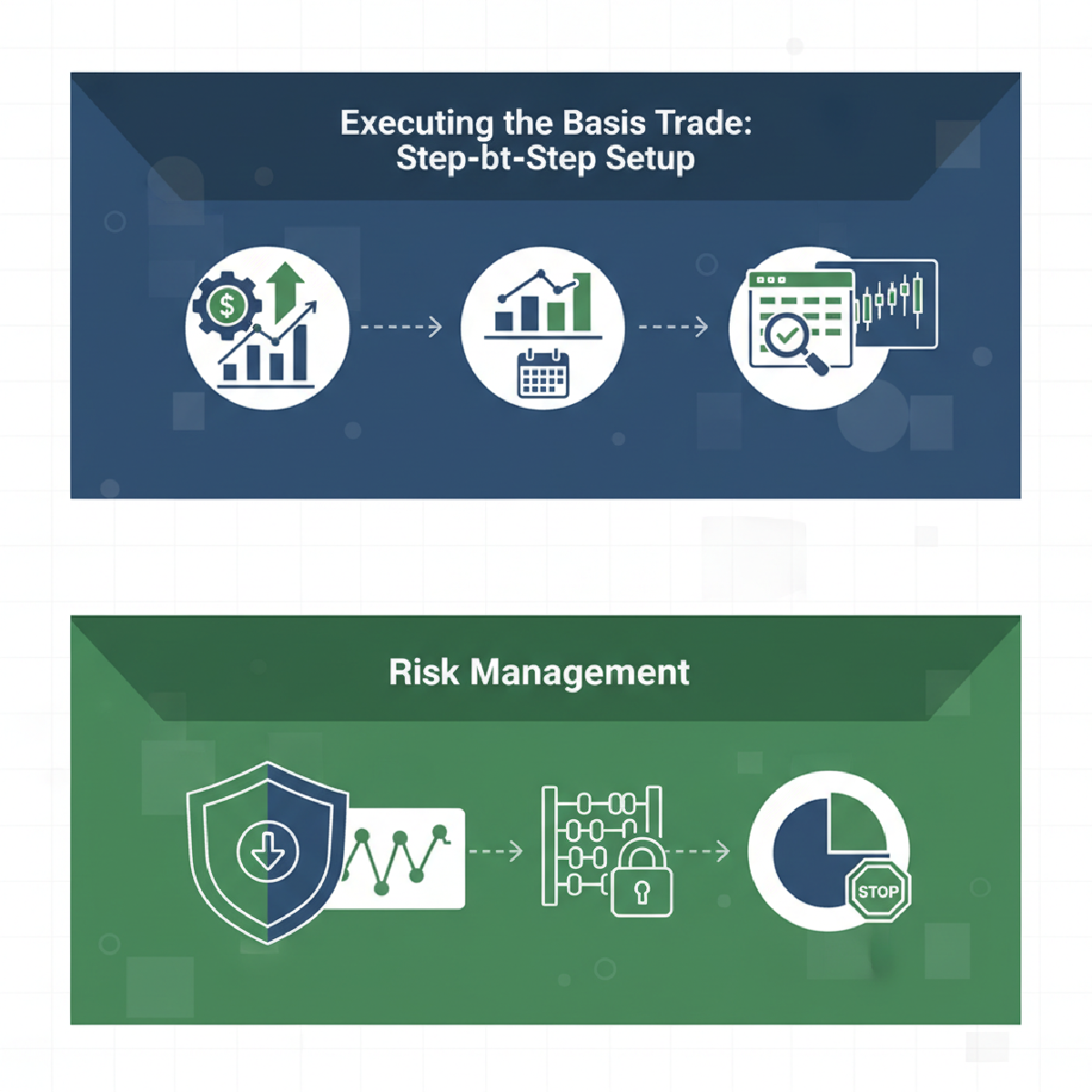
Executing the Basis Trade: Step-by-Step Setup and Risk Management
In recent months, interest in the crypto basis trade strategy has increased as traders aim to navigate market-neutral positions using Delta Adjusted Tokens (DATs) and futures contracts. If you haven’t yet reviewed Part 1, Understanding the Crypto Basis Trade, I recommend doing so to familiarize yourself with key concepts like the basis, delta neutrality, and the rationale behind going long on DATs while shorting futures.
What Is the Basis Trade Recap?
The basis trade takes advantage of the price difference between the spot price of a cryptocurrency and its corresponding futures contract. The typical approach is straightforward: you go long on the spot or DATs and short on futures. This strategy aims for delta neutrality, meaning that changes in the underlying asset’s price won’t significantly affect your net position. Profit opportunities may arise from funding rates, basis convergence, or price discrepancies.
Step 1: Choosing the Right DATs and Futures Contracts
Selecting DATs
When selecting DATs for your basis trade, focus on liquid and well-established tokens such as BTC or ETH. These tokens generally offer tighter spreads, which can facilitate smoother execution. Ensure that the DATs you choose come from reputable platforms and that their prices closely track the underlying crypto for effective hedging.
Choosing Futures Contracts
You can short futures on centralized crypto-native exchanges (like Binance Futures and Bybit) or traditional exchanges such as the CME. Here are a few considerations:
- Contract Type: Crypto-native exchanges offer both perpetual and quarterly contracts, while the CME focuses solely on quarterly contracts.
- Liquidity: Generally high on crypto-native platforms, but it’s always good to verify.
- Funding Rate: Be aware that crypto-native exchanges have active funding payments, while CME futures settle at expiry without a funding rate.
I tend to prefer perpetual futures on crypto-native platforms for basis trades due to their favorable funding rates, which can provide continuous carry opportunities.
Step 2: Calculating Notional Exposure and Achieving Delta Neutrality
Determine Your Trade Size
Your notional exposure should reflect your capital, risk tolerance, and margin requirements. For example, if you plan to deploy $50,000, you would buy $50,000 worth of DATs and short an equivalent amount in futures.
Achieving Delta Neutrality
The quantity of DATs you hold should match the quantity of futures contracts shorted in terms of underlying units, not just dollar value. Use current spot and futures prices to calculate the required quantities:
[ \text{Quantity to buy} = \frac{\text{Capital allocated}}{\text{Spot price}} ] [ \text{Quantity to short} = \frac{\text{Capital allocated}}{\text{Futures price}} ]
Be sure to account for fees or slippage to maintain an effective hedge.
Step 3: Step-by-Step Trade Execution
1. Fund Your Accounts
Start by depositing stablecoins or crypto into both your spot/DAT and futures trading accounts, ensuring you meet the margin requirements for futures trading.
2. Buy DATs (Long Spot Leg)
Go to the spot market on your chosen exchange and select your order type. A market order provides immediate execution but may involve slippage; a limit order allows for price control but could result in partial fills. Purchase the calculated quantity and monitor your average execution price after fees.
3. Short Futures (Short Leg)
Once the spot leg is completed, navigate to the futures market and open a short position for the same quantity of futures as your DAT purchase. Your order type will depend on market liquidity. Confirm that your fill is complete and note the execution price.
4. Confirm Delta Neutrality
Review your fills to ensure the quantities align closely. Calculate your position delta to confirm it’s near zero. Any mismatch can introduce what traders refer to as legging risk.
Step 4: Monitoring and Managing Key Risks
Basis Risk
Basis risk occurs when the difference between spot and futures prices widens or fails to converge as expected. Regularly monitor basis spreads and consider rolling futures contracts before expiry to mitigate potential swings.
Liquidity Risk
Liquidity risk involves the potential inability to enter or exit positions at desired prices due to thin markets. To manage this, avoid large trades that exceed typical daily volume, and always choose contracts with high liquidity.
Funding Rate Volatility
Funding rates on perpetual futures can fluctuate, affecting your profitability. Closely watch these rates and avoid entering trades right before anticipated funding spikes.
Counterparty Risk
Counterparty risk pertains to the possibility of an exchange or clearinghouse defaulting. To manage this, utilize regulated exchanges, diversify your trading venues, and regularly withdraw profits to keep collateral within safe limits.
Best Practices for Risk Management and Position Monitoring
- Automate the tracking of spot and futures prices, basis spreads, and funding rates using APIs or third-party tools.
- Set alerts for significant basis deviations that exceed your risk tolerance.
- Regularly rebalance your positions to adjust for slippage or market movements.
- Implement stop-loss or stop-limit orders on futures to limit potential losses if delta neutrality is compromised.
- Maintain a trading journal to record your trades, including entry prices and rationales.
- Practice conservative capital management; start small and gradually increase your exposure as you gain experience.
Practical Example
Suppose you want to execute a basis trade on ETH worth $50,000, with an ETH spot price of $1,800 and a perpetual futures price of $1,805. The quantity calculation would be:
[ \text{Quantity} = \frac{50,000}{1,800} \approx 27.78 \text{ ETH} ]
Buy 27.78 ETH and simultaneously short the same amount in perpetual futures. Monitor funding rates, which could fluctuate and affect your position, and closely track the basis spread, making adjustments as necessary.
Conclusion
To effectively implement the basis trade strategy, select liquid DATs and futures contracts, calculate exposure for delta neutrality, and execute trades simultaneously to minimize legging risk. Remain vigilant about funding rates and basis spreads while employing robust risk management practices. For those serious about this strategy, consider starting small. As you build confidence and gain insights from your trades, you can gradually scale your positions. Look for instances where the basis widens unexpectedly, as this may present an ideal entry point for a basis trade—especially in volatile markets.
This article may contain affiliate links. Always do your own research.