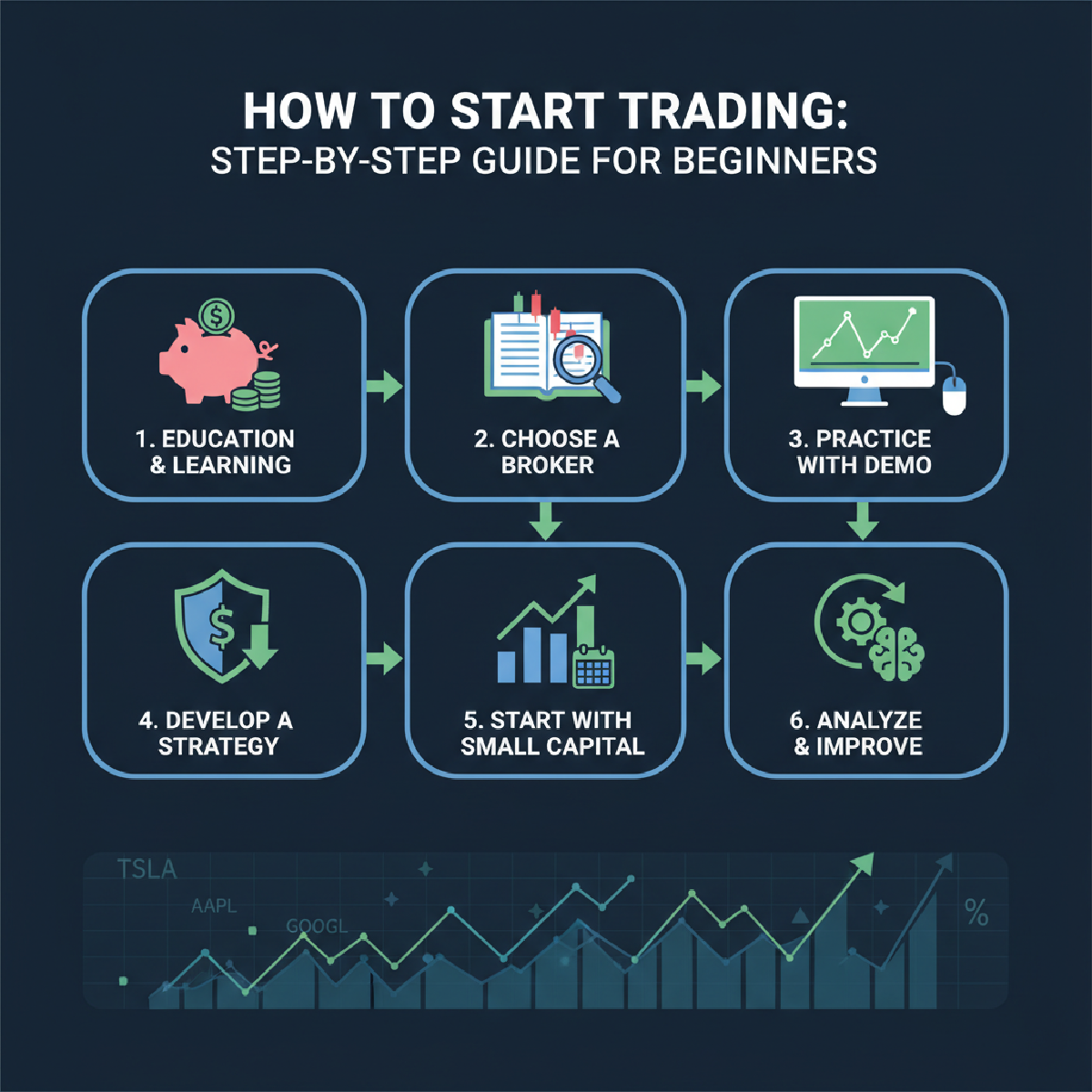
How to Start Trading: Step-by-Step Guide for Beginners
Trading in financial markets can be a practical avenue for building wealth, but it does come with its challenges. Many newcomers dive in without a solid understanding of the landscape, often encountering steep learning curves. This guide aims to provide essential steps for trading confidently, from understanding the basics to executing your first trades and managing risk effectively.
Understand What Trading Is and Choose Your Market
At its essence, trading involves buying and selling financial assets—such as stocks, currencies, commodities, or cryptocurrencies—to profit from price fluctuations. Unlike investing, which generally focuses on long-term growth, trading often operates within shorter time frames.
When selecting a market, consider the following options:
- Stocks: Shares of companies traded on exchanges.
- Forex: Currency pairs like EUR/USD, available for trading nearly 24/7.
- Commodities: Physical goods like gold and oil.
- Cryptocurrencies: Digital currencies such as Bitcoin and Ethereum.
- Indices and ETFs: Collections of stocks representing various sectors.
For example, if you have an interest in global economics and prefer the flexibility of trading at any hour, forex might be a suitable option. I’ve found that choosing a market that aligns with both my interests and risk tolerance significantly enhances my trading experience.
Educate Yourself: Learn the Basics of Trading
Before risking real money, it’s crucial to build a solid foundation. Begin by familiarizing yourself with key terminology—concepts like pips, lots, spreads, and leverage are fundamental. Understanding market mechanics and trading strategies, including technical and fundamental analysis, is essential.
Risk management is a critical aspect of trading. Learning how to set stop-loss orders, size your positions, and calculate risk/reward ratios can help protect your capital.
For instance, mastering the stop-loss order can be transformative; it automatically sells your position at a specified price, limiting potential losses. Resources like Saxo’s forex guide and Fidelity’s trading education center are excellent starting points for grasping these basics.
Choose a Reliable Broker and Open an Account
Your broker serves as your primary link to the market, making the selection of a trustworthy one essential. Look for:
- Regulation: Ensure the broker is regulated by reputable authorities like the FCA or SEC.
- Fees and Spreads: Aim for low commissions and tight spreads.
- Platform: A user-friendly interface with essential trading tools.
- Account Types: Most brokers offer demo accounts for practice.
- Markets Available: Confirm that the broker supports the assets you want to trade.
If you plan to trade both stocks and forex, ensure your chosen broker accommodates both markets. I often recommend starting with a demo account to familiarize yourself with the platform before committing real funds.
Fund Your Trading Account
Once your account is set up, deposit funds securely. Start with an amount you can afford to lose; trading with money needed for living expenses can lead to poor decision-making.
Develop a Trading Plan
A trading plan serves as your roadmap for success. It should include:
- Financial Goals: Set clear profit targets and define your time frame.
- Risk Tolerance: Decide how much of your capital you’re willing to risk on each trade.
- Trading Strategy: Outline rules for entering and exiting trades based on your analysis.
- Money Management: Establish parameters for position sizing and setting stop-loss levels.
- Review Process: Regularly evaluate your trades to learn and refine your approach.
For example, my trading plan includes a goal of achieving a 10% annual return with a maximum risk of 1.5% per trade. Having a well-defined plan has helped me maintain discipline during trading.
Practice with a Demo Account
Before transitioning to live trading, use a demo account to get accustomed to the trading platform and test your strategies. This practice allows you to understand order types, leverage, and margin without risking real money.
For instance, you might simulate a buy order for EUR/USD and set a stop-loss below your entry point. This hands-on experience is invaluable.
Place Your First Trades
When you’re ready to trade with real money, start with small initial trades. Choose your asset based on your trading plan, select the appropriate order type—whether a market or limit order—and always set stop-loss and take-profit levels to manage your risk.
For example, you could buy 100 shares of Apple (AAPL) at $150, setting a stop-loss at $145 and a take-profit at $160. Always double-check your trade details before confirming to avoid costly mistakes.
Manage Your Trades and Risk
Effective trade management involves regularly adjusting your strategy based on market conditions. For instance, consider moving your stop-loss to break even once a trade becomes profitable. Stay informed about news that may impact your trades and avoid making emotional decisions.
If a trade hits your stop-loss, accept it gracefully and analyze what went wrong. Learning from mistakes is essential for becoming a successful trader.
Continuously Learn and Improve
Trading is a skill that takes time to develop. Keep a trading journal to document your trades, including your thought process and emotional state at each decision point. Reviewing this journal weekly can reveal patterns that help you refine your strategy.
Continuing your education through trading communities, expert analyses, or advanced courses can also enhance your skills.
Specific Steps to Start Trading Forex
If you’re interested in forex trading, here’s a straightforward approach:
- Research and learn the basics of forex, including key concepts like pips and leverage.
- Open a demo account with a reputable broker such as Saxo or IG.
- Fund your real account with a manageable amount, perhaps $500.
- Develop a trading plan focused on technical indicators for your entries and exits.
- Execute your first trade, such as buying EUR/USD at 1.1000 with a stop-loss at 1.0950.
- Actively monitor your trade and adjust your stop-loss as the price moves in your favor.
- Document the trade’s outcome to refine your strategy.
Useful Resources and Tools
| Resource | Description |
|---|---|
| Saxo Learn Forex Guide | Comprehensive beginner’s guide to forex trading |
| Traders Union Beginner Guide | Step-by-step trading start guide |
| Wealth Professional Trading Guide | Detailed trading steps and risk management |
| IG Trading for Beginners | Stock and forex trading explained |
| TradingView Platform | Popular charting and analysis software |
| MetaTrader 5 | Widely used trading platform with demo features |
Starting your trading journey demands patience, discipline, and ongoing education. By following these structured steps, you can lay a solid foundation for your trading career. Remember, mistakes are part of the learning process; the key is to learn and stay committed to improvement. To achieve success, keep an eye on market trends and remain adaptable—this is essential for developing as a trader.
This article may contain affiliate links. Always do your own research.